
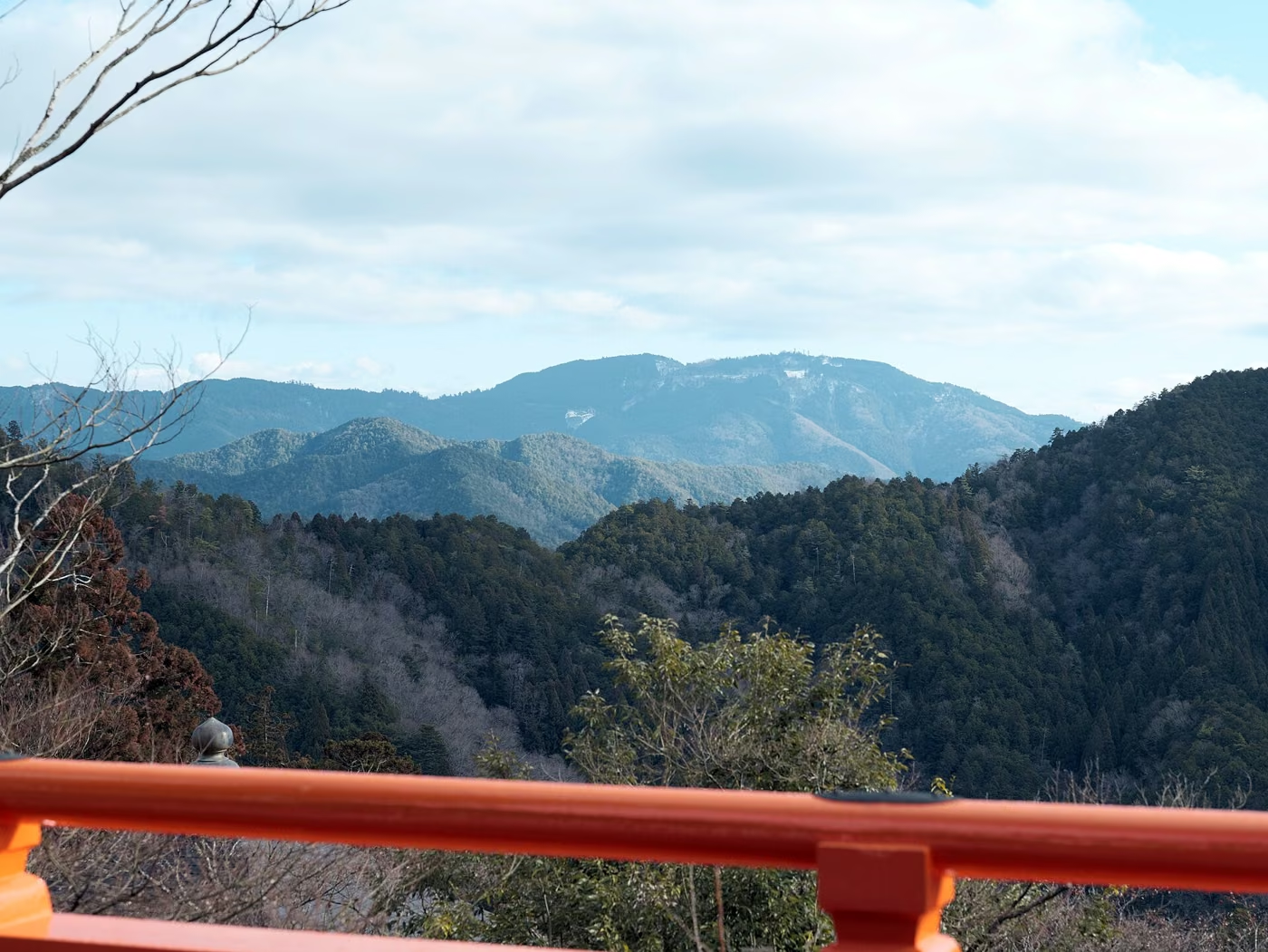
Photo: Hyppolyte de Saint-Rambert, Wikimedia Commons (CC BY 4.0). The mountains of north Kyoto seen from the grounds of Kurama-dera, January 2024.

Kurama to Kibune Hike in Kyoto: Eizan Railway, the ¥500 Kurama-dera Fee, the Tree-Root Path, Bears and Kifune Shrine's Autumn Light-Up (2026)
An English guide to the Kurama–Kibune hike in north Kyoto, the short mountain walk over Mount Kurama (鞍馬山) from Kurama-dera Temple to Kifune Shrine. Covers getting to Kurama on the Eizan Railway from Demachiyanagi and the fares, the ¥500 Aizan-hi entry fee and the optional ¥200 cable car, why the official course runs from Kurama to Kibune, the Kinone-michi tree-root path and the West Gate, the bus or road walk back to Kibuneguchi, Kifune Shrine's autumn light-up from November 7 to 24, 2026, late-autumn daylight, and what Kyoto City and Kyoto Prefecture say about bears this autumn.
This guide is based on Kurama-dera Temple (鞍馬寺), Kifune Shrine (貴船神社), the Eizan Railway (叡山電車), the Kyoto City Tourism Association, the Japan National Tourism Organization, Kyoto City and Kyoto Prefecture. Fees, timetables and opening hours can change, so open the linked pages before you go.
If you want one hike in Kyoto that feels like a real walk in the mountains but still fits into half a day by train, the Kurama–Kibune hike (鞍馬・貴船) is the usual answer. You ride a small local train into the hills north of the city, climb through the temple grounds of Kurama-dera (鞍馬寺), cross Mount Kurama (鞍馬山) on a forest path famous for its tangled tree roots, and come down into the narrow river valley of Kibune (貴船), where Kifune Shrine (貴船神社) stands among red lanterns.
The Japan National Tourism Organization (JNTO) puts the walk at 3.9 km and about two to three hours if you start from the foot of the temple, and describes it as not too difficult, with wooden steps and handrails on the steeper parts. It is short, but it is still a mountain trail, and this autumn it comes with a few things worth knowing in advance: the light-up dates at Kifune Shrine, early sunsets, and bears.
Five decisions to make before you go
1. Which direction?
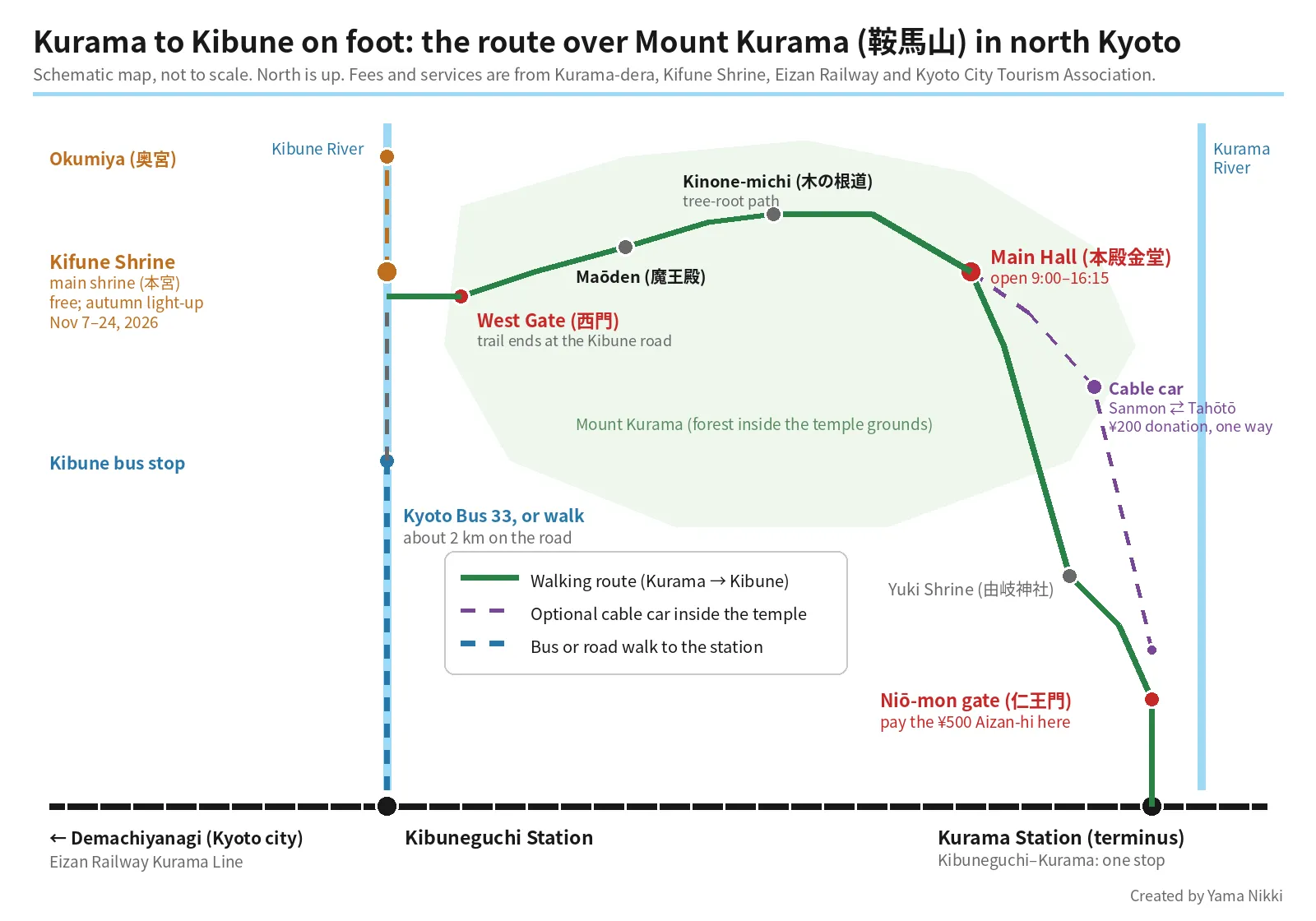
Kurama-dera's own access page describes the full walking course in one direction: Kurama Station → Niō-mon gate → Yuki Shrine → Main Hall → Maōden → Kifune Shrine → Kibuneguchi Station. This guide follows that order. Going this way, the climb through the temple comes first, and you finish in the Kibune valley next to the shrine.
2. Walk all the way up, or take the cable car?
Inside the temple grounds there is a short cable car (鞍馬山ケーブル) between Sanmon Station (山門駅) near the gate and Tahōtō Station (多宝塔駅) higher up. Kurama-dera explains that it is run by the temple to help people who find the climb hard, and that instead of a fare it asks for a donation of ¥200 one way for adults (¥100 for elementary school children and younger) (Kurama-dera, Japanese). The first car up leaves at 8:40, cars run about every 20 minutes, and Kurama-dera notes that if you take the last car up at 16:20, the Main Hall will already be closed (Kurama-dera access page, Japanese).
The temple posts maintenance stops on its news page; the next one listed is the morning of October 27, 2026. If you are fit, the walking path, the Tsuzura-ori sandō (九十九折参道), is the more interesting choice: Kurama-dera recalls that Sei Shōnagon mentioned this winding path in The Pillow Book about a thousand years ago.
3. How much will it cost?
| Item | Cost (adult) | Source |
|---|---|---|
| Eizan Railway, Demachiyanagi → Kurama | ¥470 | Eizan Railway fare table |
| Kurama-dera entry (Aizan-hi, 愛山費) | ¥500 | Kurama-dera |
| Cable car inside Kurama-dera (optional) | ¥200 donation, one way | Kurama-dera |
| Reihōden museum inside Kurama-dera (optional) | ¥200 | Kurama-dera |
| Kifune Shrine | Free | Kifune Shrine |
| Eizan Railway, Kibuneguchi → Demachiyanagi | ¥470 | Eizan Railway fare table |
Kurama-dera explains that the Aizan-hi (literally “fee for loving the mountain”) is used to keep the mountain clean, look after the forest and maintain the paths, which it deliberately leaves as natural earth. The Kyoto City Tourism Association notes that the Kyoto Bus between Kibuneguchi Station and Kifune Shrine is not covered by the Subway & Bus 1-day Pass, so carry an IC card or coins for that bus.
4. What time should you start?
Kurama-dera's Main Hall is open 9:00 to 16:15. Sunset in Kyoto, from the National Astronomical Observatory of Japan (October and November tables):
| Date (2026) | Sunrise | Sunset |
|---|---|---|
| October 25 | 6:11 | 17:11 |
| November 1 | 6:17 | 17:03 |
| November 10 | 6:26 | 16:55 |
| November 20 | 6:36 | 16:49 |
| November 30 | 6:45 | 16:46 |
The forest trail over the mountain is not lit. Plan to be at the Main Hall by late morning, so that you have JNTO's two to three hours for the walk with daylight to spare. Carry a light anyway.
5. Are you ready for bears?
Asiatic black bears (ツキノワグマ) live in the mountains around Kyoto. Kyoto City reports bear sightings in and near the mountains within the city, and people were injured by bears in the city's mountains in August 2023 and June 2026. The city says that bears look for food intensively in autumn before hibernation, and that sightings usually continue until around early December. Kyoto Prefecture adds that the 2026 crop of beech-family nuts (acorns), a key bear food, is poor, which raises the chance of bears coming near villages.
What the city and prefecture ask hikers to do:
- Walk with other people where you can, and make noise with a bell or whistle so that bears know you are there.
- Be especially careful in the early morning and evening, and when fog, wind or a nearby river makes it hard for a bear to hear you.
- If you see a cub, leave quickly: the mother is probably close.
- If you meet a bear, do not turn your back; move away slowly. If it is very close, crouch and protect your head and neck with your arms.
- Kyoto City also suggests carrying bear spray when you enter bear habitat, and wearing a helmet and a backpack.
A map of reported sightings is linked from the Kyoto Prefecture page above. For more detail, see our bear safety guide for hikers in Japan.
Getting to Kurama
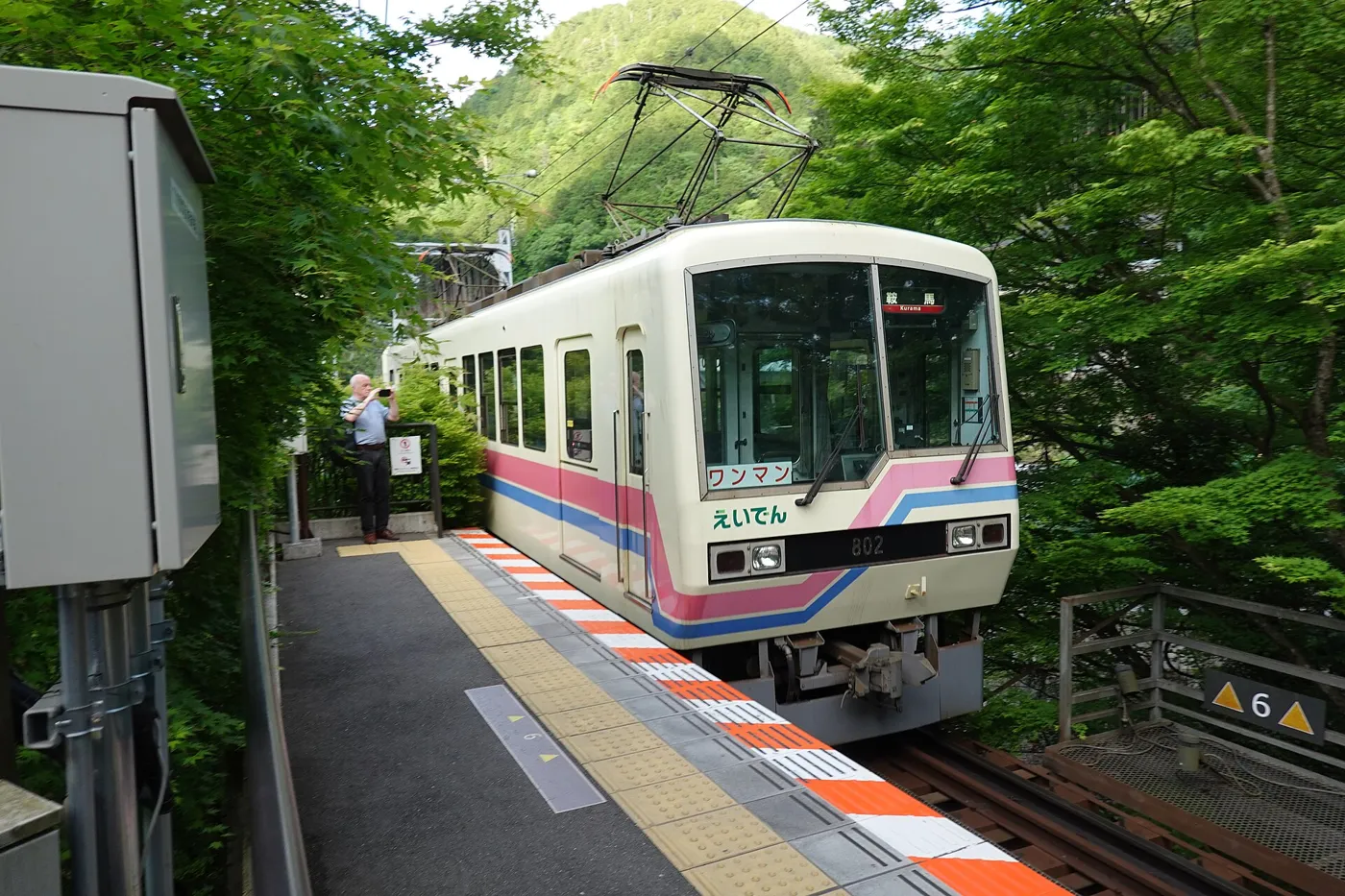

The simplest way is the Eizan Railway Kurama Line (叡山電車 鞍馬線) from Demachiyanagi (出町柳) to its terminus, Kurama (鞍馬). The Kyoto City Tourism Association gives about 30 minutes for the ride. To reach Demachiyanagi:
- From Kyoto Station: JR Nara Line one stop to Tōfukuji (東福寺), then the Keihan Line to its terminus, Demachiyanagi (about 12 minutes). Leave Keihan's Demachiyanagi through the north ticket gate; the Eizan Railway station is above ground next to it (Kyoto City Tourism Association).
- From the Gion and Shijō Kawaramachi area: Keihan Line from Gion-Shijō (祇園四条) to Demachiyanagi, about 7 minutes.
There is also a bus option: the Kyoto City Subway Karasuma Line to Kokusaikaikan (国際会館), then Kyoto Bus 52 toward Kurama Onsen. Kurama-dera gives about 25 minutes for the bus to the Kurama stop. The tourism association notes that this bus leaves the area covered by the Subway & Bus 1-day Pass, so you pay an extra fare.
By car: Kurama-dera has no parking of its own, only lots in the area. Kifune Shrine has very few spaces (it lists 10 at the main shrine and 5 at the Okumiya, ¥1,000 for 2 hours) and recommends public transport or parking near Kokusaikaikan or Demachiyanagi and continuing by train (Kifune Shrine access). On this hike you start and finish in different valleys anyway, which suits the train.
While you are on the train: the Eizan Railway calls the stretch between Ichihara (市原) and Ninose (二ノ瀬) the Momiji Tunnel (もみじのトンネル), about 250 m of track lined with roughly 280 maple trees. The railway says the leaves usually turn from early to late November, and that the tunnel can only be seen from the train (Eizan Railway, Japanese).
The walk, section by section
Kurama Station to the Niō-mon gate
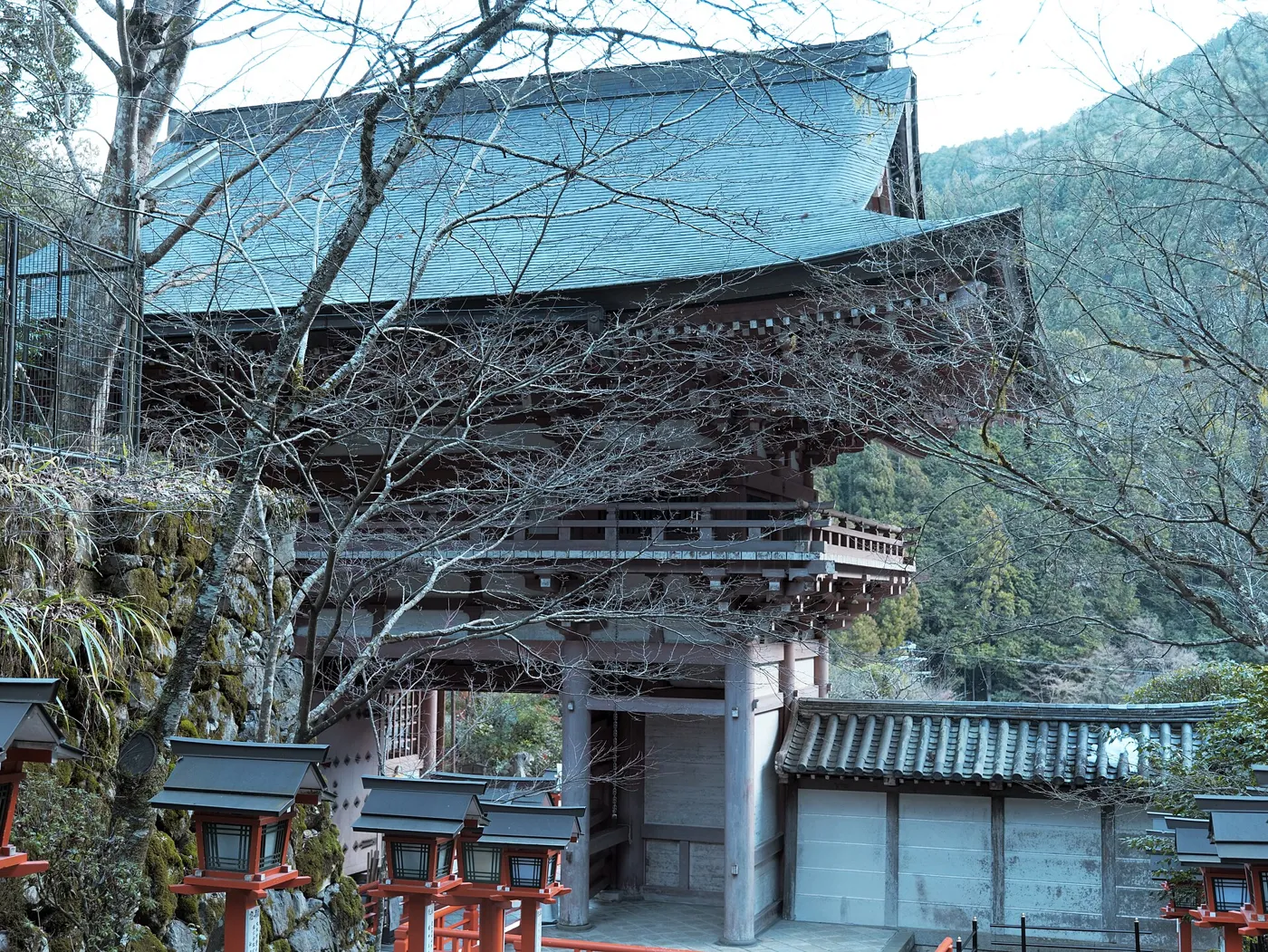
The Niō-mon gate (仁王門, also called the Sanmon) is about three minutes' walk north of Kurama Station, according to Kurama-dera. This is where you pay the Aizan-hi. Kurama-dera says the left-hand door of the gate dates from the 1180s, while the gate itself was rebuilt in 1911. There are toilets at the foot of the mountain near the cable car station, and more inside the temple grounds.

Up the Tsuzura-ori path to the Main Hall
Kurama-dera's walking course gives about 5 minutes from the gate to Yuki Shrine (由岐神社), then about 20 minutes up the zigzag Tsuzura-ori path to the Main Hall (本殿金堂, Honden Kondō). Yuki Shrine stands inside the temple grounds, and its sacred cedar, the Ōsugi-san, is about 800 years old and 53 m tall, according to the shrine. Much of the path is stone steps.
From the temple grounds there are views over the mountains of north Kyoto, as in the photo at the top of this page. Kurama-dera's Main Hall closes at 16:15, so do not leave this part too late.
Over the mountain: the Kinone-michi and Maōden
Behind the Main Hall the path becomes a forest trail. Kurama-dera gives about 30 minutes from the Main Hall to Maōden (魔王殿), the small hall deep in the woods, and about 20 minutes from Maōden down to Kifune Shrine. On the way you pass:
- Sekurabe-ishi (背比べ石), a stone associated with the young Minamoto no Yoshitsune, who according to legend trained on Mount Kurama with the tengu mountain goblins;
- the Kinone-michi (木の根道), or tree-root path: the cedar roots cannot push down into the hard ground, so they spread across the surface in a dense net (JNTO);
- Ōsugi Gongen-sha (大杉権現社) and Fudō-dō (不動堂) and Yoshitsune-dō (義経堂), small halls along the ridge, before Maōden.
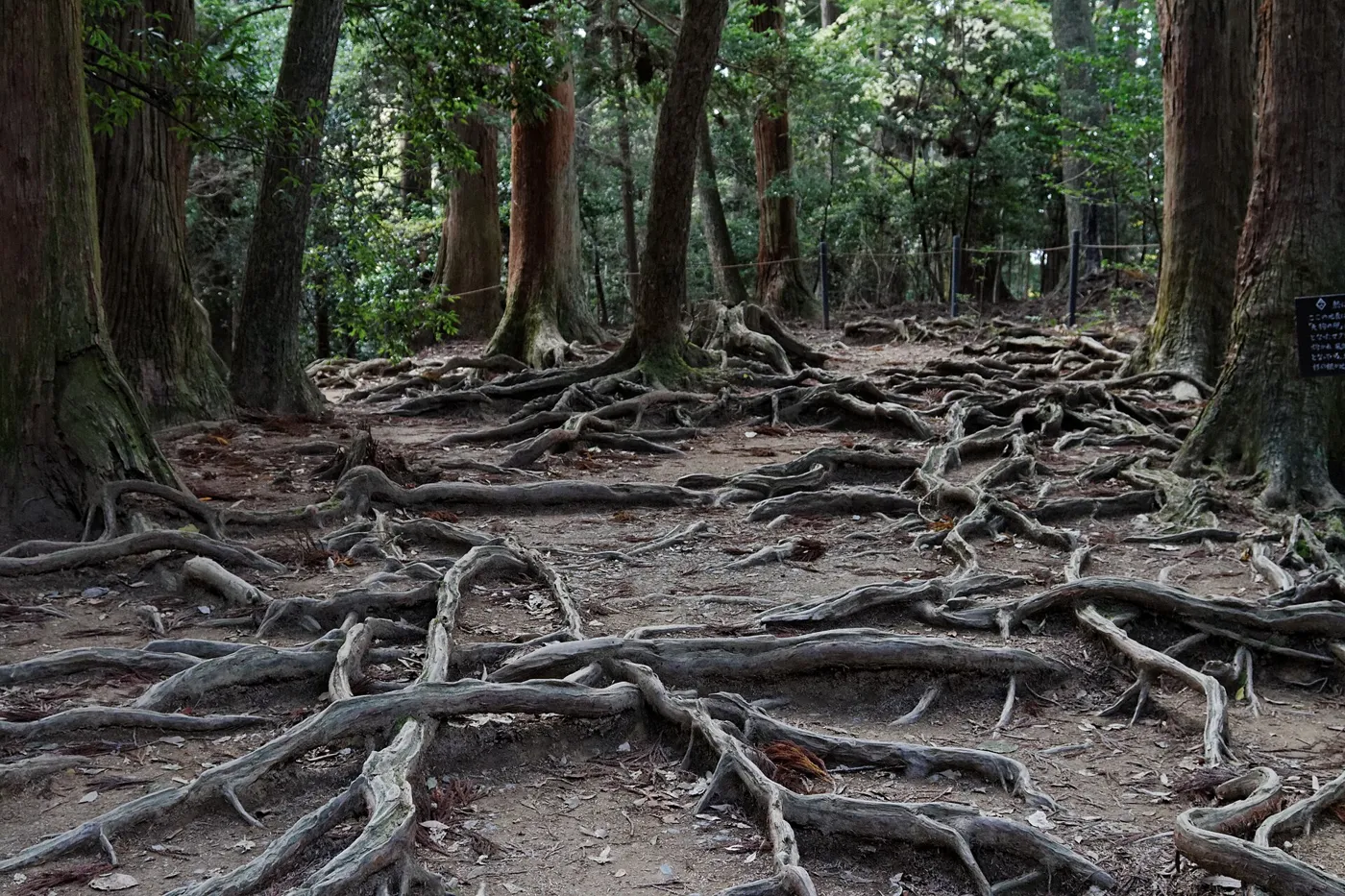

The roots are the part to take slowly. They are uneven and become slippery after rain, and the descent from Maōden to Kibune is steep in places. Shoes with a proper tread make a real difference; the Eizan Railway, which runs guided walks in this area, recommends trekking shoes rather than walking shoes for its mountain routes (Eizan Railway hiking page, Japanese).
The trail leaves Kurama-dera at the West Gate (西門, Nishimon) and comes out on the road along the Kibune River.
Kibune and Kifune Shrine
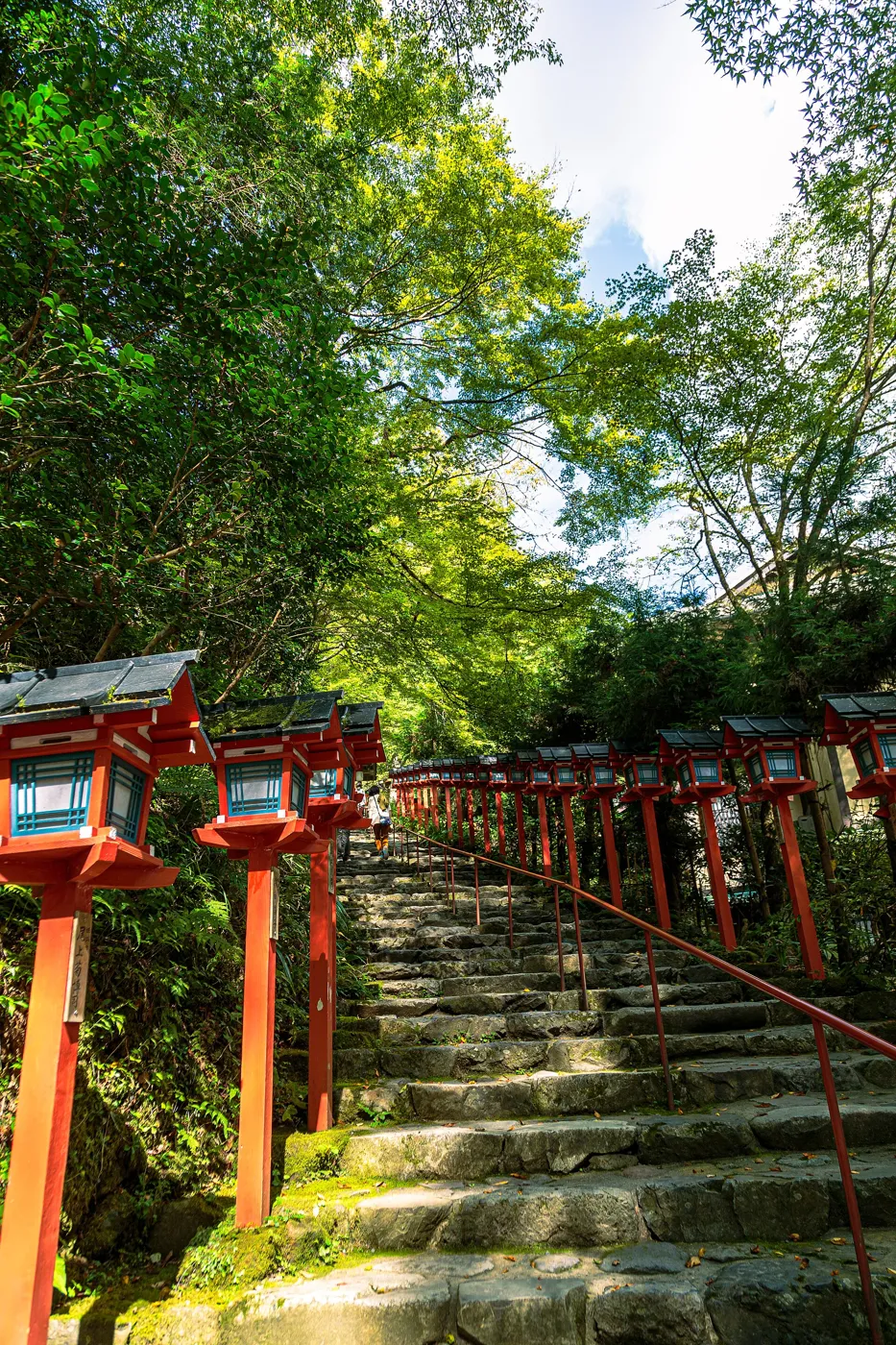

Kifune Shrine enshrines the god of water and, according to the shrine, is the head shrine of some two thousand water shrines across Japan. A visit traditionally covers three sites: the main shrine (本宮, Hongū), the Okumiya (奥宮) further up the valley, and Yui-no-yashiro (結社). Entry is free.
Opening hours at the main shrine, as posted by Kifune Shrine:
- 6:00 to 20:00 from May 1 to November 30 (Kifune Shrine). The shrine sometimes changes this for busy days, so check its news page; for example, it announced 6:00 to 17:00 for October 10 and 11, 2026.
- Autumn light-up 2026: November 7 (Sat) to November 24 (Tue), from sunset to 20:30, at the main shrine and the Okumiya. The amulet office stays open 9:00 to 20:00 during this period (Kifune Shrine news, Japanese).
If you want to see the light-up, do the hike in daylight first and wait in Kibune for dark, rather than starting late and crossing the mountain at dusk. Kurama-dera's Main Hall closes at 16:15, and the forest trail is not lit.

Back to Kibuneguchi Station
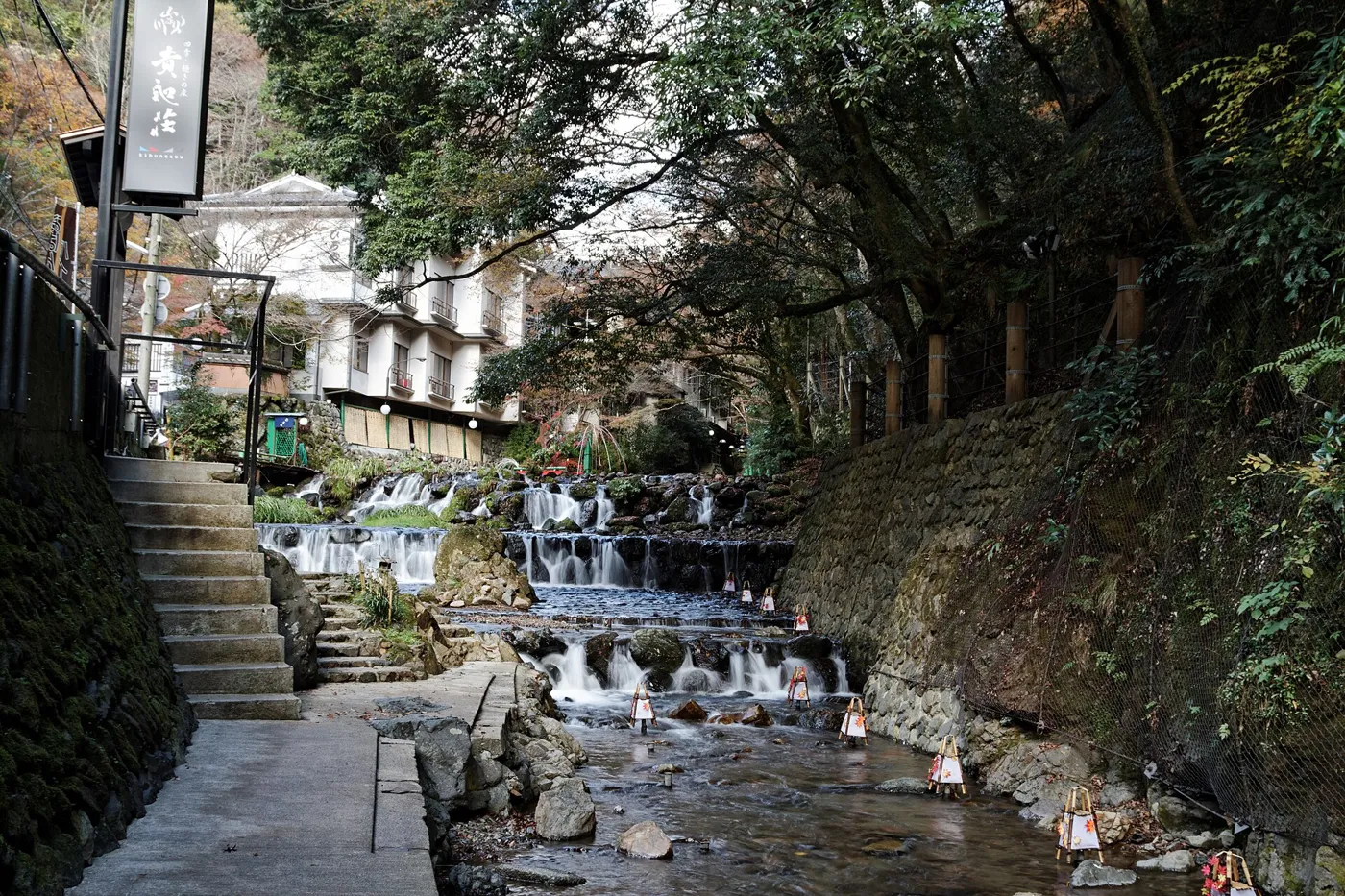
The shrine is in the valley; the nearest station, Kibuneguchi (貴船口), is down at the main road. Kifune Shrine gives two ways back:
- Kyoto Bus 33 from the Kibune (貴船) stop, about 5 minutes' walk below the shrine, to Kibuneguchi Ekimae (貴船口駅前). The Kyoto City Tourism Association gives about 7 minutes for the ride. Check the timetable on the Kyoto Bus website (Japanese) before you start, especially for the return in the late afternoon.
- Walk down the road beside the river. Kifune Shrine puts the distance from Kibuneguchi Station at about 2 km (around 30 minutes), and Kurama-dera's walking course allows about 40 minutes from the shrine to the station. The road is also used by cars and buses.
From Kibuneguchi, Eizan Railway trains run back to Demachiyanagi (¥470) in about 28 minutes, according to the tourism association.
What to bring
The Eizan Railway's list for its own guided walks in these hills is a good starting point for a late-autumn day: lunch and a drink, a hat, gloves, rain gear, a towel, a change of clothes, and warm clothing depending on season and weather (Eizan Railway hiking page, Japanese). To that, add:
- Shoes with grip for wet stone steps and roots;
- a bell or other noise-maker, as Kyoto City and Kyoto Prefecture recommend in bear country;
- a light, given the sunset times above;
- cash or an IC card for the Aizan-hi, the cable car donation and the Kibune bus;
- a bag for your trash: Kurama-dera regards the mountain itself as sacred and stresses keeping it clean.
Kurama-dera allows pets on the mountain, but not on the cable car or inside the halls (Kurama-dera, Japanese). In an emergency in Japan, dial 110 for the police or 119 for fire and ambulance; for how rescue and insurance work for visitors, see our Japan hiking basics.
Related guides on Yama Nikki
- Bear safety for hikers in Japan — which bears live where, and what to do if you meet one.
- Japan hiking basics for visitors — climbing plans, emergency numbers, rescue costs and insurance.
- Mount Rokko to Arima Onsen — another one-way hike in Kansai that ends in a valley town, near Kobe.
- Mount Mitake day trip from Tokyo — a sacred mountain with a cable car, shrine and forest walk near Tokyo.
References
- Kurama-dera — Access and walking courses (Japanese)
- Kurama-dera — Visiting the mountain: Aizan-hi, cable car and museum (Japanese)
- Kurama-dera — Guide to the temple grounds (Japanese)
- Kurama-dera — News and cable car maintenance (Japanese)
- Kifune Shrine (English)
- Kifune Shrine — Transport and access (English)
- Kifune Shrine — Autumn light-up 2026 (Japanese)
- Eizan Railway — Fares (Japanese)
- Eizan Railway — Momiji Tunnel (Japanese)
- Eizan Railway — Hiking (Japanese)
- Kyoto City Tourism Association — Comfortable access to Kurama / Kibune
- Japan National Tourism Organization — Kurama
- Yuki Shrine (Japanese)
- Kyoto Bus — Timetables (Japanese)
- Kyoto City — Avoiding Asiatic black bears (Japanese)
- Kyoto Prefecture — Asiatic black bears and sightings (Japanese)
- National Astronomical Observatory of Japan — Sunrise and sunset, Kyoto, October 2026 (Japanese)
- National Astronomical Observatory of Japan — Sunrise and sunset, Kyoto, November 2026 (Japanese)