

Photo: lumoplank, Wikimedia Commons (CC0). Visitors walking through larch trees in autumn colors at Kamikochi, November 7, 2025 (cropped).

Japan Hiking Basics for Visitors: Climbing Plans, Emergency Numbers, Rescue Costs, Toilets and Trash
What visitors should know before hiking in Japan. Covers when a climbing plan (tozan-todoke) is required by prefectural ordinance, how to submit one, the emergency numbers 110 and 119, rescue costs and insurance, portable toilets, carrying out trash, and huts, based on prefectural and Ministry of the Environment pages.
This guide is based on prefectural and Ministry of the Environment pages, many in Japanese. Rules differ by prefecture, mountain and season, and they change. Check the official page for your mountain before you go.
Hiking in Japan is easy to start, and the trails are well maintained. But the rules are not all the same everywhere, and some of them surprise visitors: a climbing plan can be legally required, mountain rescue costs can be high, and many places expect you to carry out your own trash and, in some areas, your own toilet waste. This guide answers the basic questions in one place.
Quick answers
| Question | Short answer |
|---|---|
| Do I need to submit a climbing plan? | Only in certain areas and seasons (see the table below), but it is strongly recommended everywhere |
| What is the emergency number? | 110 (police) or 119 (fire and ambulance), if your phone has a signal |
| What if there is no signal? | Go to the nearest mountain hut and ask for help |
| Will the government rescue me for free? | Not covered by the sources used here. Nagano Prefecture warns that a private rescue team can charge a large fee, and recommends insurance that covers rescue costs |
| Where do I put my trash? | Nowhere on the mountain. Take it home |
| Do I need a portable toilet? | Only where the area asks for it (for example Yakushima), but it can be useful elsewhere |
Climbing plans (登山届, tozan-todoke)
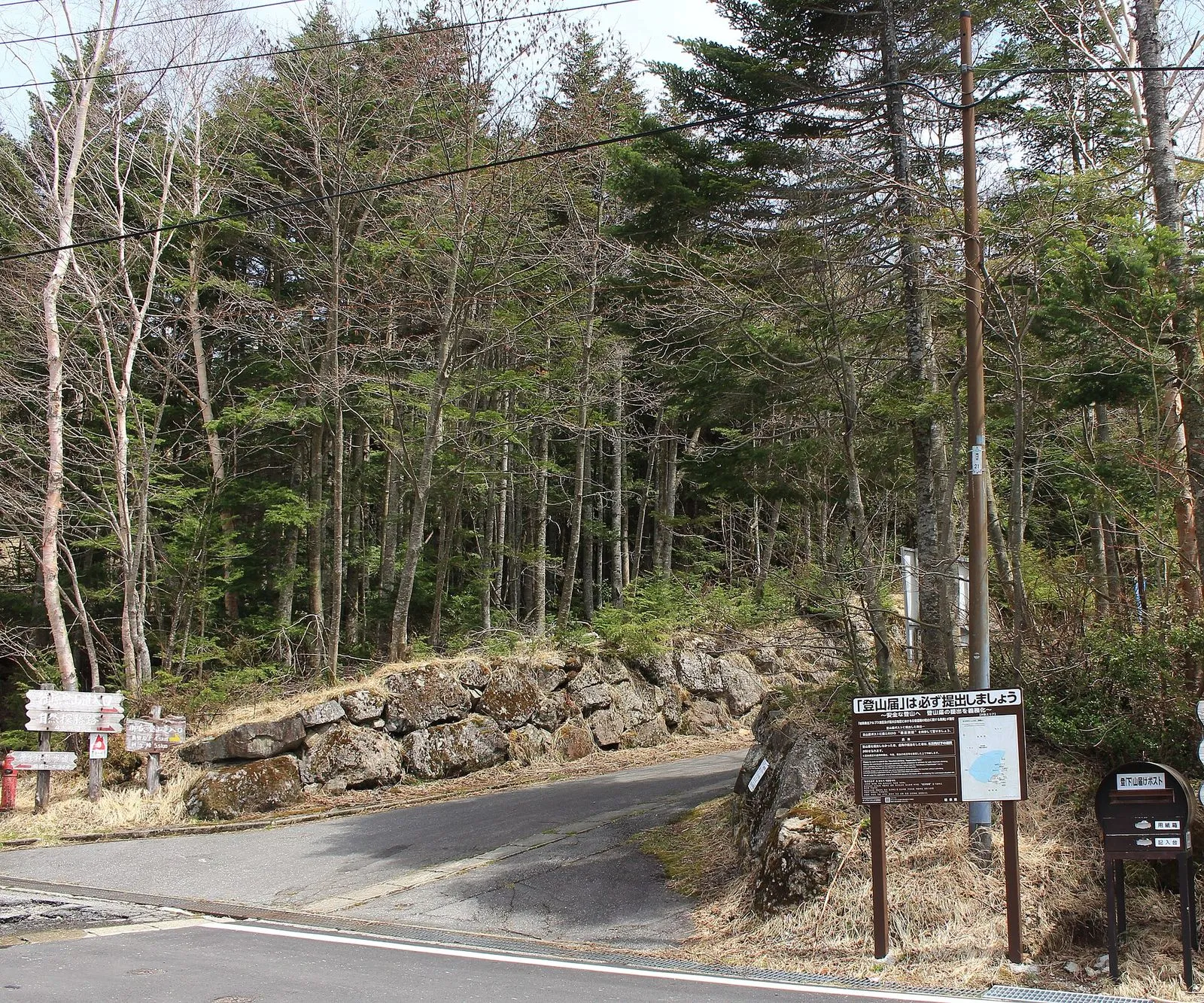
A climbing plan tells people on the ground who you are, where you are going and when you should be back. Nagano Prefecture explains that it helps rescuers work faster in an emergency, and its English guidelines ask hikers to leave a copy with family or friends.

Where submission is required by ordinance
Some prefectures require a climbing plan for specific mountains. These are examples drawn from each prefecture's own page; the details (the exact area, season and penalties) are in the sources.
| Prefecture | Where and when | Official source |
|---|---|---|
| Nagano | Designated trails (the list is on the prefecture's site). The English guidelines say that submission became mandatory on July 1, 2016 | Nagano: Trekking Itineraries |
| Gifu | The Northern Alps area and areas around active volcanoes (Ontake, Yake-dake, Hakusan, Norikura-dake), under the prefecture's ordinance | Gifu ordinance text (PDF, Japanese) |
| Toyama | Mt. Tsurugi and surrounding mountains from December 1 to May 15, submitted 20 days before the climb | Toyama Prefecture (Japanese) |
| Yamanashi | From December 1 to March 31: Mt. Fuji above 3,000 m on the Yamanashi side, parts of the Southern Alps, and Yatsugatake peaks. Submission is also strongly encouraged year-round in some areas, including Fuji above roughly the 6th station | Yamanashi Prefecture (Japanese) |
Gunma Prefecture also has an ordinance covering Mt. Tanigawa. An overview of the prefectural ordinances is in this local government research foundation page (Japanese). Several prefectures set penalties for not submitting; for example, the foundation says Gifu's is a fine of up to 50,000 yen.
If your mountain is not in this list, submission may not be required, but it is still a good idea.
How to submit
Nagano Prefecture's pages list these options. The Japanese page recommends submitting online, for privacy and faster rescue work:
- Online, through the prefecture's e-application system.
- Trailhead post box (some trailheads do not have one).
- Mail to the Mountain and Highland Tourism Division in Nagano City.
- Fax to +81-3-6862-5035 (the number is the same across Nagano Prefecture, and the English page says you can send from a convenience store or hotel).
The paper form can be written in English or Japanese. Nagano's Japanese page also says that if your plans change you should submit again, and that you do not need to report cancelling or coming down. Carry your plan with you on the day.
Toyama and Yamanashi also list the app Compass (コンパス) among their accepted ways to submit. The service is at mt-compass.com. Whether the app's English interface covers your needs is something to check yourself.
Emergency numbers and rescue
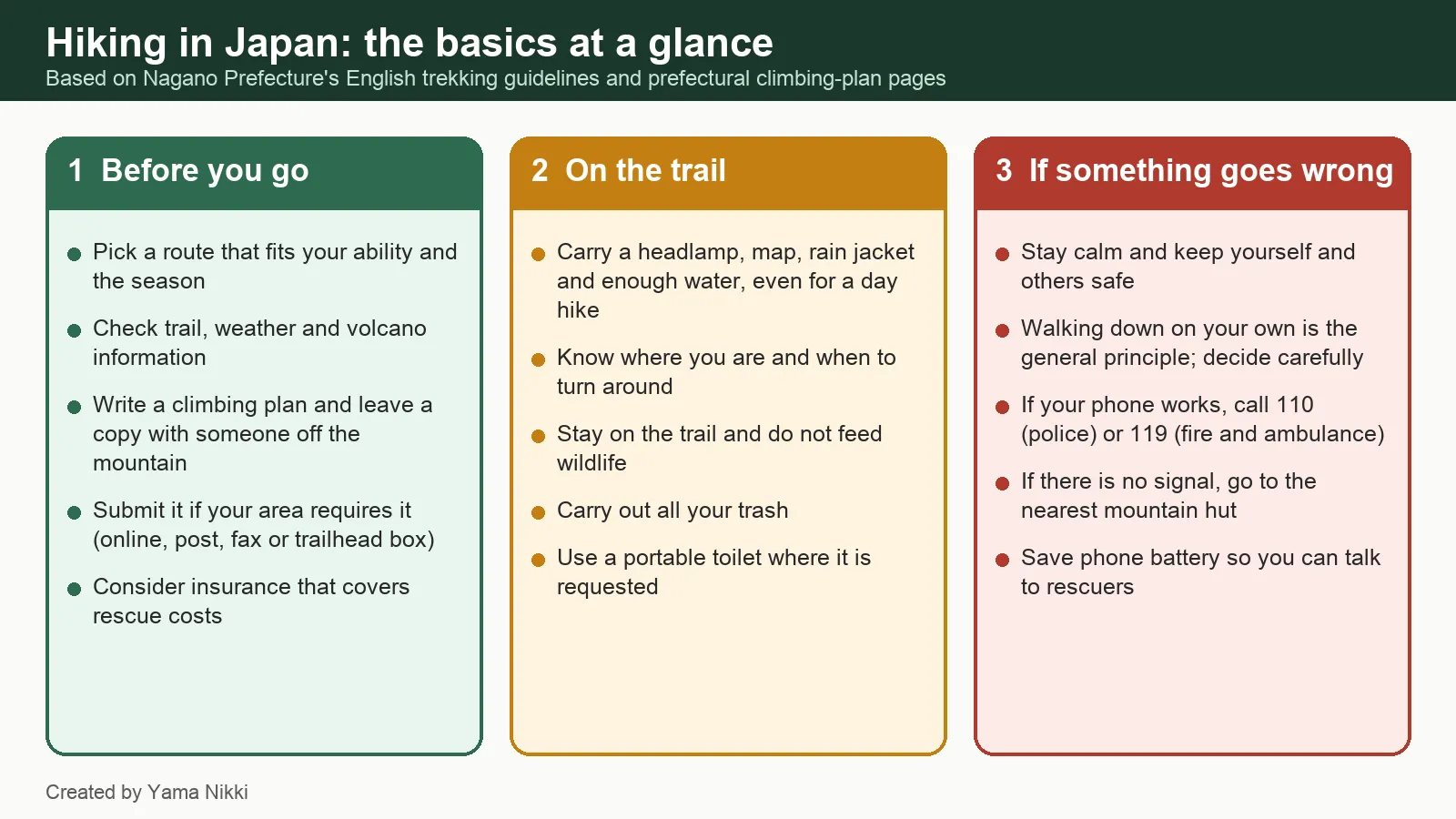
Nagano Prefecture's English guidelines say:
- Stay calm and make yourself and others safe first.
- The general principle is to come down from the mountain on your own. Ask for rescue after carefully judging your situation.
- If your phone works, call 110 or 119.
- If you are out of range, contact the nearest mountain hut.
- Keep a way to communicate, and keep your phone battery charged for talking with rescuers.
Nagano Prefectural Police have a mountain safety division and an English page with mountain safety information.
Rescue costs and insurance
Nagano's English guidelines say that when a private rescue team is dispatched, the rescued person is charged a hefty fee, and recommend trekking insurance that covers rescue costs for accidents. Gifu's ordinance also asks on its form whether you have insurance for search and rescue costs. The sources used here do not set out which rescue services are free or paid, so check with the insurer and the local authority.
The same guidelines also say you must act at your own risk in the mountains and that accidents can happen to anyone.
What to carry
Nagano's English guidelines say that even for a day trip you should carry a headlamp, map, compass, rain jacket and enough water, and a warm layer suited to the altitude and season. They advise against cotton underwear, and suggest packing spare clothes in a waterproof bag. They also recommend leaving early, planning a turn-around time, and checking trail conditions and the weather forecast before you leave.
Toilets, trash and nature
Trash
Nagano's guidelines are clear: do not bring things that become trash, and take any trash home with you. Kusatsu Town, for example, says there will be no trash cans at its Kusatsu-Shirane trial opening and that everyone must carry out their own trash.
Portable toilets
In some national parks, the Ministry of the Environment asks hikers to use portable toilets because mountain toilets are few and the waste is carried out by people. On Yakushima Island, the ministry's English page asks hikers on Mt. Miyanoura to bring one, and says used ones go in a collection box or home with you, not left in the booth. In Shiretoko, a booth on the Iwaobetsu course is reserved for portable toilet users, and used ones go to a collection box. See the ministry's Yakushima page and Shiretoko page (Japanese).
Outside those areas, there is usually no such requirement, but a portable toilet can be useful on a trail with few toilets.
Nature
Nagano's guidelines also ask hikers to stay on the trail, not take plants, animals or stones home, not feed wildlife, and, as a general rule, not to bring pets. Clean mud from your boots before entering the mountains, to avoid carrying in seeds and foreign species. Follow the instructions of rangers.
Mountain huts and courtesy
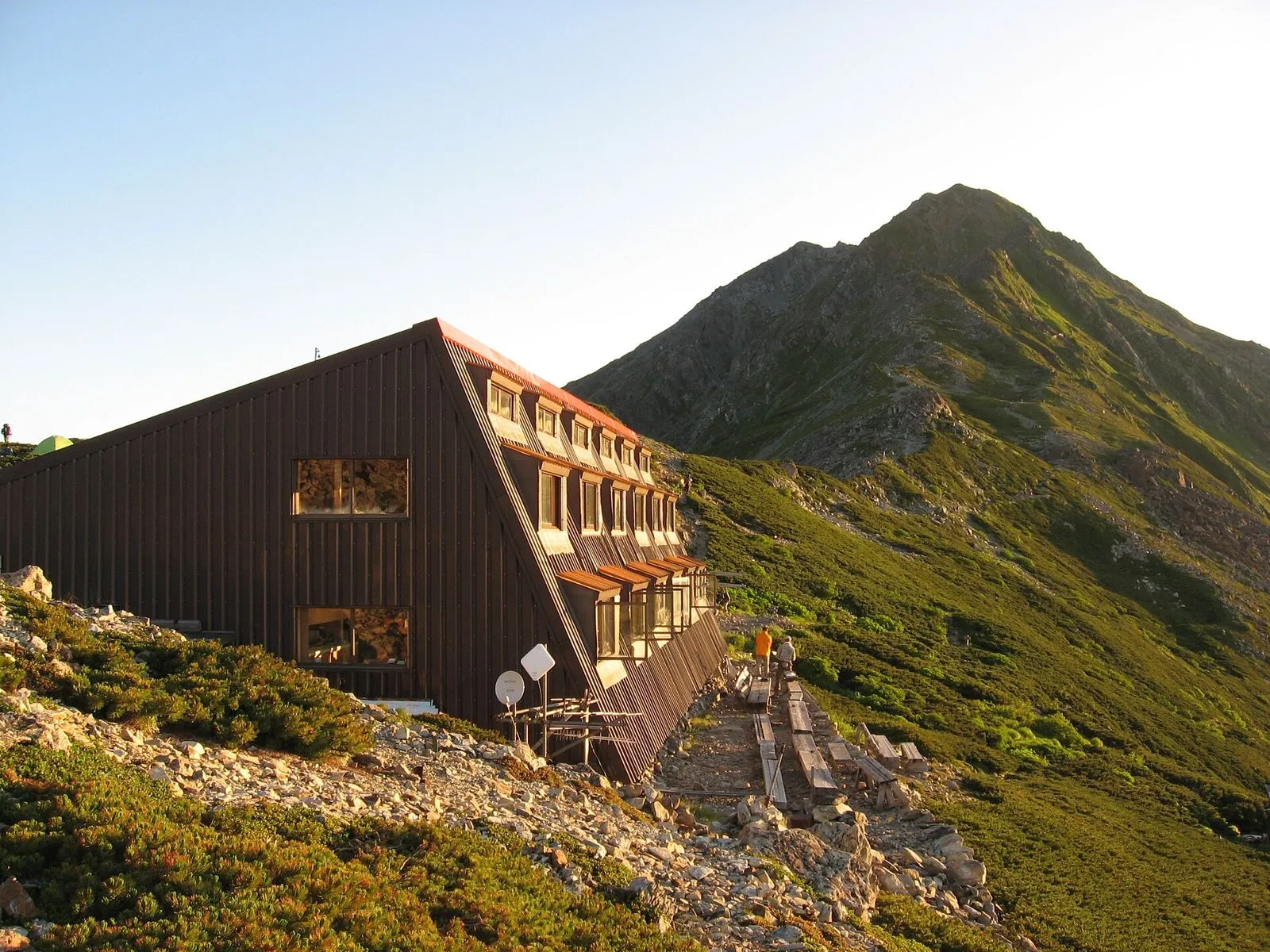
Nagano's guidelines say to arrive at a hut before sunset, not to cause trouble with noise late at night or early in the morning, and not to waste water. On the trail, share the space: yield to others, wait on the mountain side when letting people pass, and if a rock falls, shout "Raku!" so people below can hear. For a worked example of hut booking, see our guide to Mt. Fuji mountain huts.

Volcanoes and bears
Two risks are easy to miss as a visitor:
- Volcanoes. Nagano's guidelines say to check whether a mountain is volcanic, check volcano news before and during your trip, and obey access restrictions. The Kusatsu-Shirane trial opening is an example of how strict volcano rules can be.
- Bears. In autumn especially, read our bear safety guide.
Summary
- A climbing plan is mandatory in some places (Nagano designated trails, Gifu's Northern Alps and volcano areas, Toyama's Tsurugi in winter, and Yamanashi's high peaks in winter). Submit one even where it is not required.
- Call 110 or 119 if you have a signal. If not, go to the nearest hut.
- Rescue by a private team can be expensive, and insurance that covers rescue costs is recommended by Nagano.
- Carry your trash out, and use a portable toilet where the area asks.
- Check volcano and bear information for your mountain on the day.
References
- Nagano Prefecture: Trekking Itineraries (English)
- Nagano Prefecture: Enjoy Safe Mountain Trekking in NAGANO! (English PDF)
- Nagano Prefecture: Climbing plan submission (Japanese)
- Nagano Prefectural Police: English page
- Gifu Prefecture: Ordinance on mountain accident prevention in the Northern Alps and active volcano areas (PDF, Japanese)
- Toyama Prefecture: Climbing plan submission under the Toyama ordinance (Japanese)
- Yamanashi Prefecture: Climbing and mountain information portal (Japanese)
- Research Institute for Local Government: Mountain safety ordinances (Japanese)
- Compass: climbing plan and map app (Japanese)
- Ministry of the Environment: Using toilets, Yakushima (English)
- Ministry of the Environment: Climbing Mt. Rausu and the Shiretoko range (Japanese)
- Kusatsu Town: Partial opening of Mt. Kusatsu-Shirane (Japanese)
Pages marked Japanese are the official sources. This is a summary for planning and not legal advice.
Related articles
- Bear Safety for Hikers in Japan: Season, Where to Check Sightings, Bells, Spray, and What to Do If You Meet One
- Kusatsu-Shirane's Yugama Crater Lake Reopens October 13, 2026: Hours, Free Parking, Rules, and What to Expect
- Mt. Takao Day Trip from Tokyo: Getting There from Shinjuku, Cable Car Prices, Trails, and the 2026 Autumn Rules
- Mt. Fuji Mountain Huts: How to Book, What They Cost, and the 2026 Rules to Plan Your 2027 Climb