

Photo: Alpsdake, Wikimedia Commons (CC BY-SA 3.0). An Asian black bear on Mt. Kurai, Japan, February 20, 2011 (cropped).

Bear Safety for Hikers in Japan: Season, Where to Check Sightings, Bells, Spray, and What to Do If You Meet One
A practical guide for visitors hiking in Japan during bear season. Based on Ministry of the Environment guidance, it covers where bears live, how to check recent sightings, how bells, radios and bear spray are used, what to do if you see or are attacked by a bear, and how to read the warning signs.
This guide is based on Japanese government sources (Ministry of the Environment, Japan Tourism Agency and prefectures), most of them in Japanese. It does not replace local information. Sightings and closures change daily, so check the area you plan to visit just before you go.
Bears live in many of the mountain areas that visitors hike in Japan, including national parks. The Ministry of the Environment (MOE) says bears normally avoid people, but a surprise encounter can be dangerous. Most of the advice comes down to one idea: let the bear know you are there, and do not meet it by surprise.
Why this matters right now
MOE's provisional figures for fiscal year 2025 (April 2025 to March 2026) are the highest on record for bear sightings, people injured, and deaths, according to a Cabinet Secretariat document. The ministry's monthly table for that year shows how much autumn matters:
| Fiscal 2025 (provisional) | Incidents of human injury |
|---|---|
| Whole year (April to March) | 216 incidents, 238 people injured, 13 deaths |
| September | 37 incidents |
| October | 78 incidents |
| November | 32 incidents |
These numbers include all kinds of incidents (for example, in villages), not only on hiking trails. MOE labels them as provisional and says they may change. The point for hikers is that October is the peak month, so this is a season to be careful, not to skip the mountains. Sources: MOE injury table and MOE bear information page (both in Japanese).
Which bears, where, and when
According to MOE's national park guidance:
- Asian black bear (ツキノワグマ, tsukinowaguma, also called the Japanese black bear) lives on Honshu and part of Shikoku. It is a forest animal that eats mostly plants and nuts, and also insects.
- Brown bear (ヒグマ, higuma) lives in Hokkaido. Its home range can be very large.
- Bears are generally active from about March to November and hibernate from about December to February, though warm winters and regional differences can shift this.
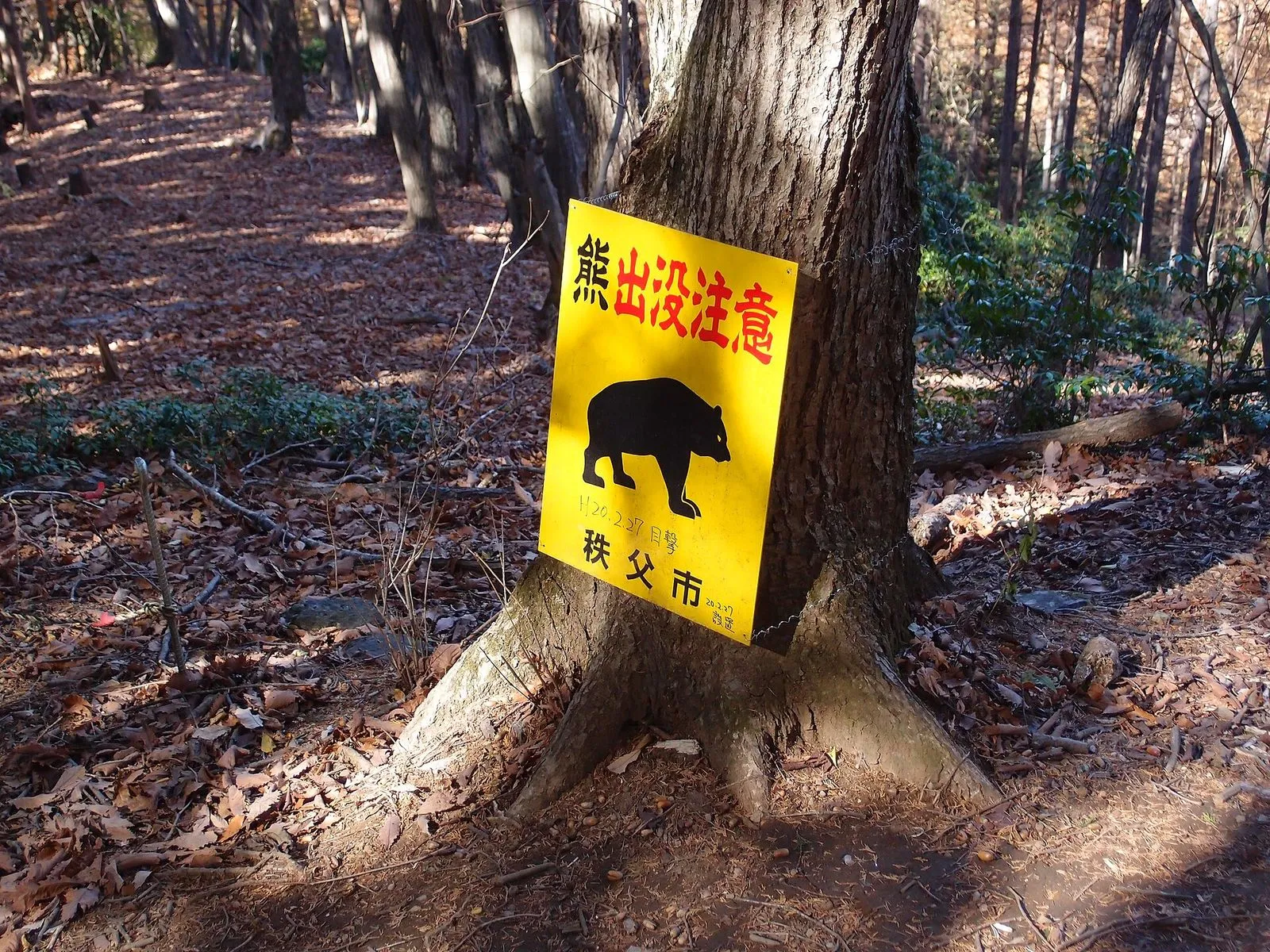

Before you go: check recent sightings
MOE asks visitors to do two things before a national park trip:
- Check the prefecture's website for recent bear sightings in the area you plan to visit.
- Stop at the visitor center to ask about local rules, manners and the latest sightings.
Many prefectures publish sighting maps, though most are only in Japanese. MOE's national park bear page links to the relevant prefecture or village pages for each park. A few examples named there:
| Area | Official sighting information named by MOE (Japanese) |
|---|---|
| Akita (Towada-Hachimantai National Park) | Akita Prefecture's bear map system, "Kumadasu" |
| Tokyo, Saitama, Yamanashi, Nagano (Chichibu-Tama-Kai National Park) | Each prefecture's bear sighting map, including Tokyo's "TOKYO Kumappu" |
| Nagano, Toyama, Gifu (Chubu-Sangaku National Park) | Nagano's bear information map, plus pages from Toyama and Gifu |
| Hokkaido (for example Shiretoko, Daisetsuzan) | Town, national park and visitor center pages for brown bear information |
Tip: if a page is only in Japanese, a browser's page translation is usually good enough to see "where" and "when." The Japan Tourism Agency has also published an English bear warning flyer and pictograms (page in Japanese) made with MOE.
Gear that helps
Bells and radios: to be heard
MOE recommends making noise with a bell or radio, clapping or calling out so bears know you are coming. Be especially careful in these conditions:
- bad weather and dusk (MOE's manual says people and bears notice each other less easily then), and
- places with poor visibility, along streams, in strong wind or in rain, where bears and people can fail to notice each other.
MOE's guidance for the Chubu-Sangaku National Park adds a few useful details:
- A bell does not scare bears away; it simply lets them know you are there.
- Pick one that carries far and rings naturally as you walk.
- In crowded, open places or inside huts, it is polite to mute it. Some bells have a mute function.
- Do not rely on a bell alone, and keep watching your surroundings.
Bear spray: a last resort
MOE recommends carrying bear spray in case of an encounter. Points from the official guidance:
- Keep it in a holster within quick reach, never buried in your pack.
- Check the expiration date before each trip and keep it away from hot cars and direct sun.
- Read the maker's instructions in advance. MOE's Chubu-Sangaku guideline says the effective range is set by each manufacturer and is often about 9 m or less, and that spraying too early reduces the effect and can put you at risk. Miyagi Prefecture's guidance quotes a shorter range of 4 to 5 meters and a spray time of 4 to 5 seconds, and says not to be overconfident because the spray is hard to handle. The range depends on the product, so read yours.
- You cannot take bear spray on an airplane, in carry-on or checked bags. MOE asks visitors to confirm where they can buy or rent it after landing.
Neither a bell nor spray replaces good habits. Miyagi Prefecture's guidance states that the most dangerous situation is a bear and a person meeting suddenly without noticing each other.
On the trail
MOE's tips for avoiding encounters:
- Avoid hiking alone if you can.
- Be extra careful in places with poor visibility, along streams, in strong wind, and in rain.
- Keep your "no surprise" habits all the way to the trailhead. Do not relax until you are back down.
- Stay on the trail. Miyagi Prefecture warns that leaving the path while gathering wild plants makes encounters more likely.
- Manage your food and trash. At campsites, do not leave food, bags or trash outside, not even in front of your tent. Seal everything, and use food lockers or containers where provided.
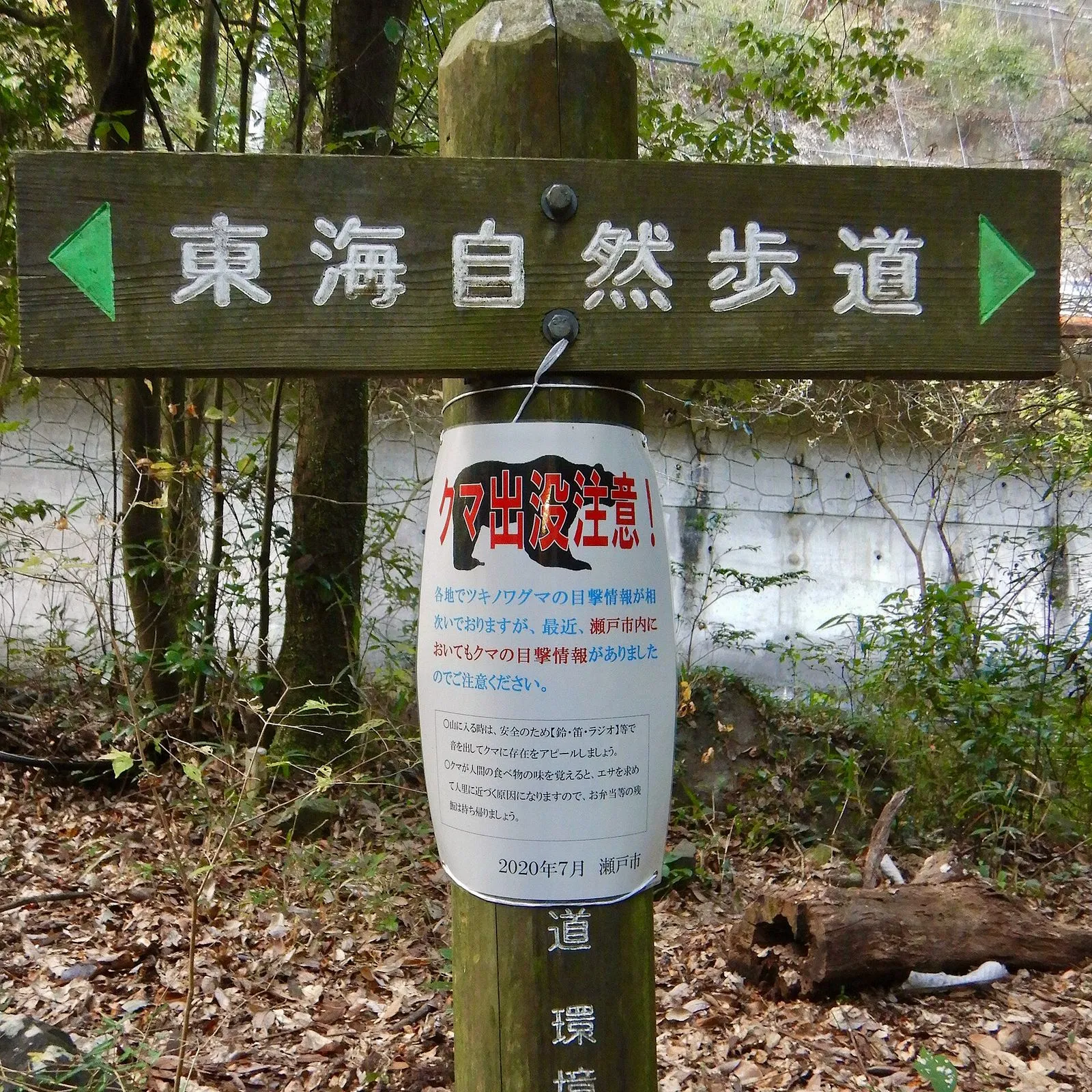

If you see or meet a bear
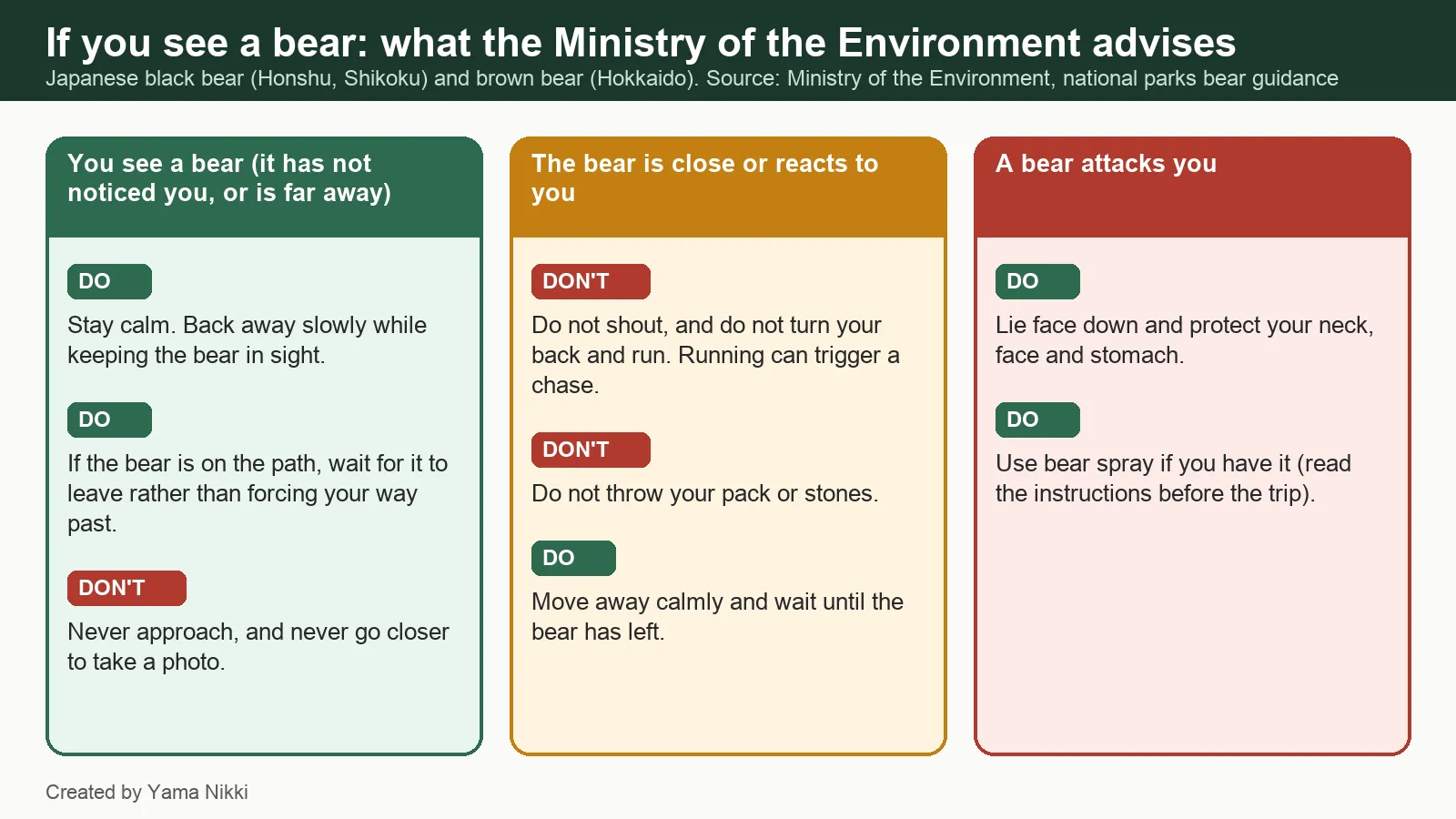
This is MOE's guidance for visitors to national parks.
If you see a bear:
- Never approach it, and do not get closer to take a photo.
- Stay calm and back away slowly, keeping your eyes on the bear.
- If the bear is blocking the path, do not try to force your way past. Wait until it leaves.
If a bear is close or reacts to you, do not provoke it:
- Do not shout.
- Do not turn your back and run, because running can trigger a chase by instinct.
- Do not throw your pack or stones.
If a bear attacks:
- Lie face down and protect your neck, face and stomach.
- If you carry bear spray, use it (you should have read the instructions beforehand).
For emergencies in the mountains, Nagano Prefecture's English guidelines say to call 110 or 119 if your phone works, and to go to the nearest mountain hut if there is no signal. See our guide to hiking basics in Japan.
Practical checklist
- Check recent sightings on the prefecture or park site, and stop at the visitor center if there is one.
- Carry a bell or radio, and mute it only where people are many or a hut is near.
- If you rent or buy bear spray, learn how to use it before the hike. Remember it cannot fly.
- Avoid hiking alone, and avoid dusk, bad weather and places with poor visibility.
- Keep all food and trash sealed and take trash home.
- If you see a bear, back away slowly. Do not run.
- Note that some places close when a bear appears. For example, Kusatsu Town says it will close the Kusatsu-Shirane trial opening if a bear is seen.
References
- Ministry of the Environment: What to know about bears before visiting a national park (Japanese)
- Ministry of the Environment: Guidelines for black bear countermeasures in mountain areas of Chubu-Sangaku National Park (PDF) (Japanese)
- Ministry of the Environment: Bear encounter response manual (PDF) (Japanese)
- Ministry of the Environment: Bear information and provisional figures (Japanese)
- Ministry of the Environment: Provisional table of human injuries by bears, fiscal 2025 (PDF) (Japanese)
- Cabinet Secretariat: Current situation of bear damage and countermeasures (PDF) (Japanese). Source for the statement that fiscal 2025 set records for sightings, injuries and deaths.
- Japan Tourism Agency: Tools for bear warnings to tourists (Japanese, with an English flyer)
- Miyagi Prefecture: How to avoid damage from Asian black bears (Japanese)
- Nagano Prefecture: Enjoy Safe Mountain Trekking in NAGANO! (English PDF)
- Kusatsu Town: Partial opening of Mt. Kusatsu-Shirane (October 8, 2026) (Japanese)
Pages marked Japanese are the official sources. This article is a summary of them and not a legal or medical advisory.
Related articles
- Japan Hiking Basics for Visitors: Climbing Plans, Rescue, Insurance, Toilets and Trash
- Kusatsu-Shirane's Yugama Crater Lake Reopens October 13, 2026: Hours, Free Parking, Rules, and What to Expect
- Mt. Takao Day Trip from Tokyo: Getting There from Shinjuku, Cable Car Prices, Trails, and the 2026 Autumn Rules
- Mt. Fuji Mountain Huts: How to Book, What They Cost, and the 2026 Rules to Plan Your 2027 Climb