
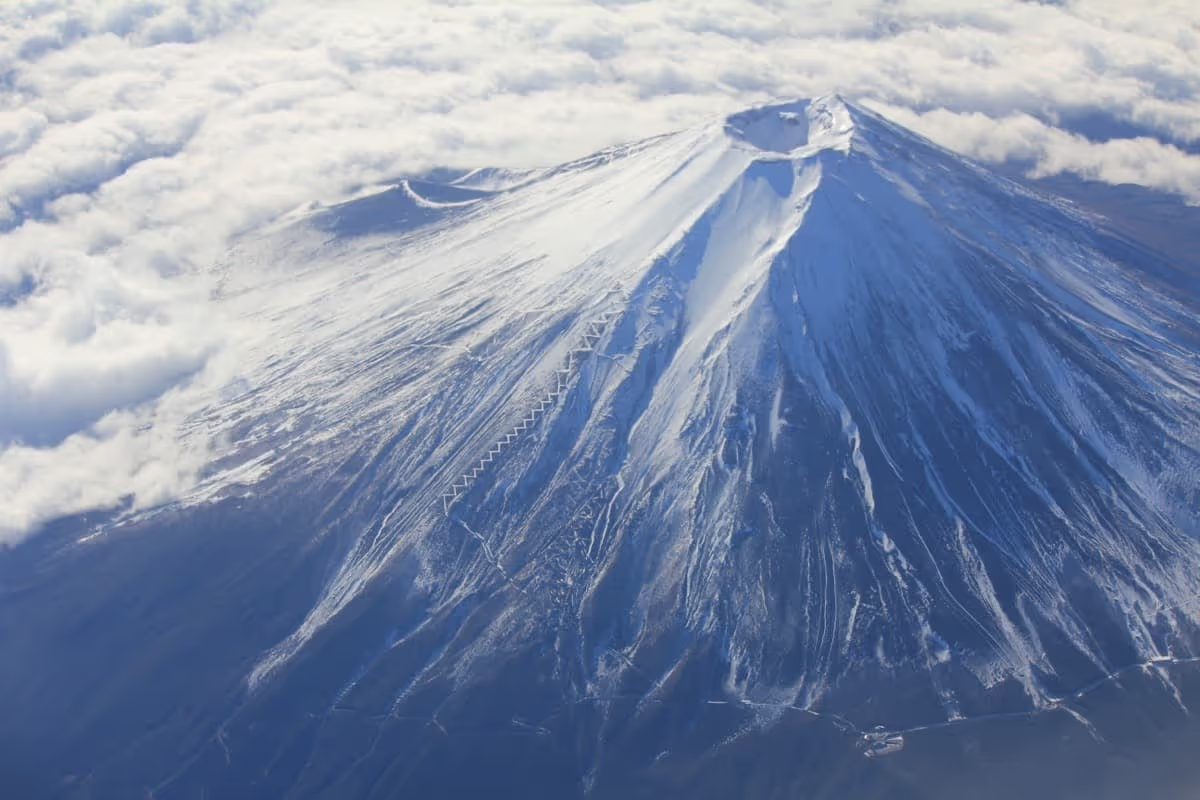
Photo: XIIIfromTOKYO, Wikimedia Commons (CC BY-SA 4.0)

Mt. Fuji Mountain Huts: How to Book, What They Cost, and the 2026 Rules to Plan Your 2027 Climb
A practical guide to Mt. Fuji mountain huts for international visitors, based on official 2026 information. Covers booking and payment, an example of hut prices, the 4,000 yen climbing fee, the 2 PM to 3 AM gate rule, the Yoshida Trail daily cap, FUJI NAVI, altitude sickness, and what to do now that the 2026 season has ended.
Updated on October 10, 2026, using the Official Website for Mt. Fuji Climbing, Yamanashi and Shizuoka prefecture notices, and individual hut websites. The 2026 climbing season ended on September 10. The rules and prices below are the 2026 ones. The 2027 rules, season dates, and hut prices have not been announced, so use this guide as a planning baseline and check the official pages again in spring 2027.
Can I Climb Mt. Fuji Right Now?
No. The Official Website for Mt. Fuji Climbing says the 2026 season has ended and that all trails to the summit are closed for the winter: the Yoshida, Subashiri, and Gotemba trails above the 5th station, and the Fujinomiya Trail above the 6th station.
Outside the season, the Road Act (Article 46) closes the trail from the 5th station to the summit, and violators may be penalized. Mountain huts and first-aid stations are closed, and the official site warns of severe weather and strong winds. In autumn and winter, stay at the 5th station area or below. See the official notice on climbing outside the season.

The 2026 Rules at a Glance
Why this matters for huts: in 2026, a hut booking is also what allows you to start climbing in the afternoon or at night.
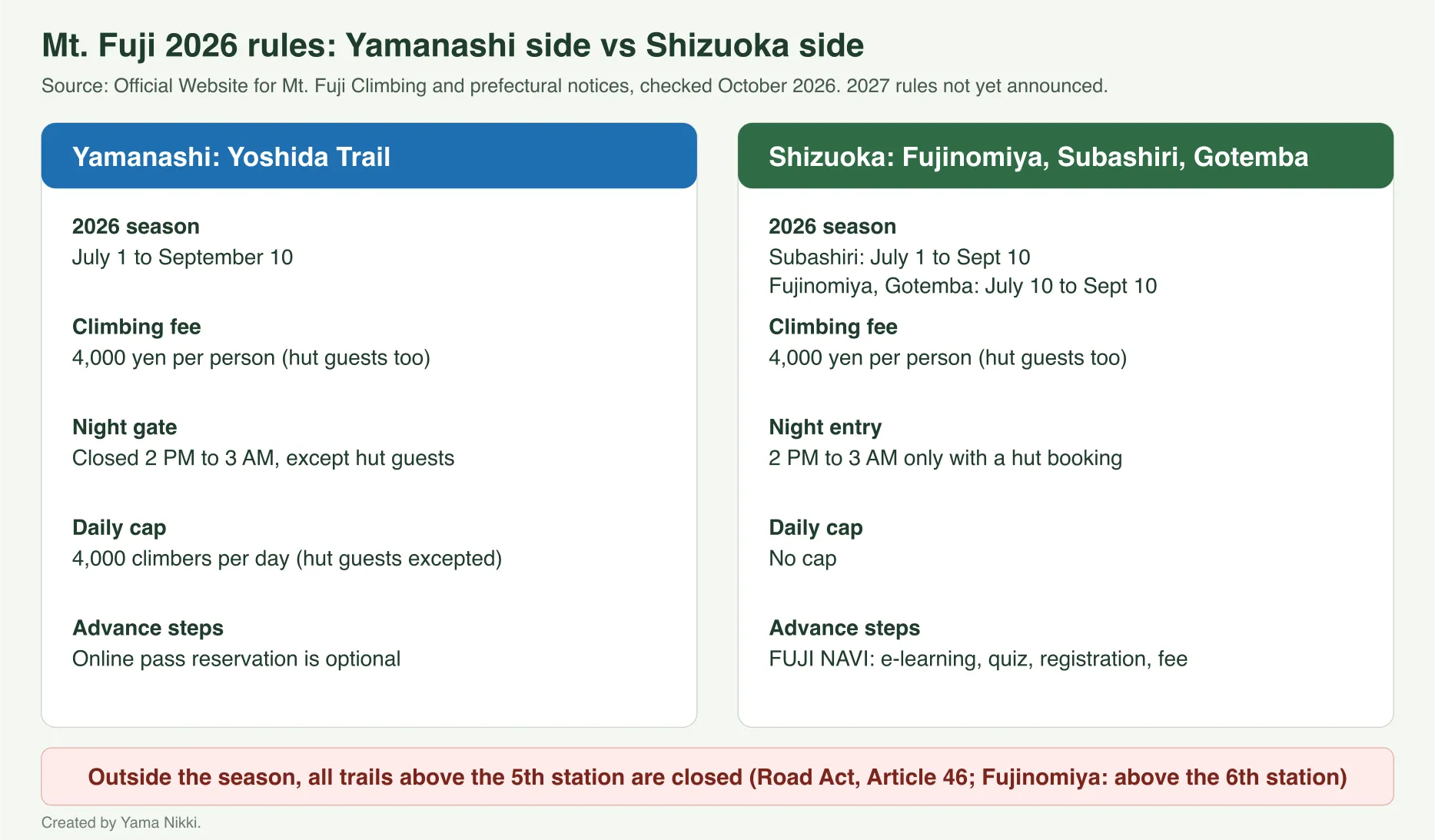
| Item | 2026 rule |
|---|---|
| Climbing fee | 4,000 yen per person per climb, all ages, including hut guests |
| Gate (Yoshida Trail) | Closed 2:00 PM to 3:00 AM. Hut guests are exempt. You can always descend |
| Daily cap (Yoshida Trail) | Gate also closes at 4,000 climbers per day (hut guests excepted). Official figures: 0 days over the limit in 2024 and 2025 |
| Shizuoka side | No daily cap. FUJI NAVI registration and a safety quiz are required |
| Bullet climbing | Climbing through the night without a hut stay is prohibited by the climber's pledge and discouraged by both prefectures |
| Gear check | Cold-weather clothing, separate (two-piece) rain gear, and proper climbing footwear |
Even with a hut booking, the official site asks you to pass the 5th station gate before 2 PM for safety.
For the full rules, including children, exemptions, and refunds, see our Mt. Fuji climbing rules explainer (Simplified Chinese) or the official pages listed at the end.
Do I Need a Hut Booking?
Not strictly, but in practice, yes, if you want sunrise.
- Without a hut booking you can still climb, but only through the gate between 3:00 AM and 2:00 PM, and if the Yoshida Trail daily cap has not been reached. That means a long single-day climb.
- With a hut booking you may pass the gate after 2 PM, and you can sleep before the summit push.
The two systems are separate. On the Yamanashi side, the optional online "pass reservation" (4,000 yen prepaid) is not a hut booking, and FUJI NAVI on the Shizuoka side cannot book a hut. You book huts directly with each hut.
If the gate asks for proof of a hut stay (after 2 PM, or once the cap is reached), the official site says to show your hut reservation confirmation email. Print it or save a screenshot so you can show it offline.
Which Route?
All four routes are open only in the season. The official site gives these 2026 dates: Yoshida and Subashiri from July 1, Fujinomiya and Gotemba from July 10, all closing September 10.
| Route | Prefecture | What the official site says |
|---|---|---|
| Yoshida | Yamanashi | More huts than the other routes, so it is considered easier to plan. Starts at the Fuji-Subaru Line 5th Station |
| Fujinomiya | Shizuoka | Fewer huts than Yoshida, but the shortest walking distance to the summit |
| Subashiri | Shizuoka | Merges with the Yoshida Trail at the 8th station, so huts from there on are shared |
| Gotemba | Shizuoka | Fewest huts, so check carefully before departure |
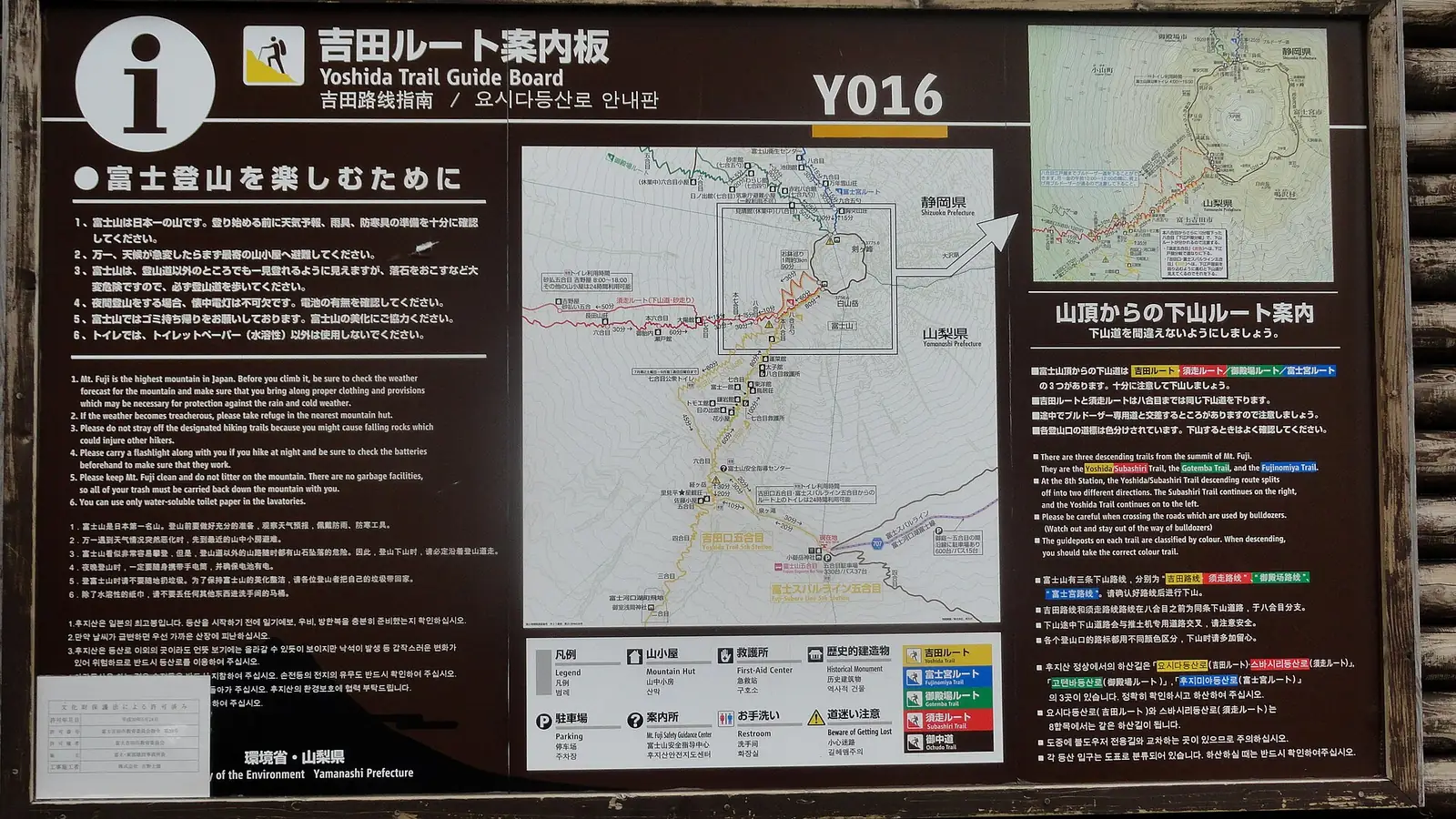
For a first visit, the Yoshida Trail is the usual choice. Be careful near the 8th station: the official site notes that the descent trails of the Yoshida and Subashiri routes diverge there and that many hikers mistakenly go down the wrong one. Learn your route's color coding.
.jpg)
How to Book a Hut
Mt. Fuji huts run on an advance-booking system and open only during the season. Booking methods and payment differ from hut to hut, so read each hut's own page.
- Pick your route and a hut location that matches how far you can climb in one day.
- Find the hut's website on the official lists: Yoshida Trail huts and Fujinomiya Trail huts. The Subashiri and Gotemba lists are on the same site (Subashiri, Gotemba).
- Check the opening date for reservations. It is set by each hut. In 2026, for example, Tomoekan opened online reservations on May 11, and the climbing season started July 1.
- Read the cancellation rules, check-in deadline, and payment method before you confirm.
- Save the confirmation email offline.
English and payment: an example (Tomoekan)
Not every hut has an English page. Tomoekan, which runs huts at the 7th station and the Original 8th station on the Yoshida Trail, has an English reservation page, so it is a useful example of how a typical booking works. This is Tomoekan's 2026 policy only; other huts differ.
- Online only. The page says it does not accept bookings from tours or travel agencies.
- Payment by credit card in advance, accepted 2 to 90 days before your stay. A booking not paid 10 days before the stay is cancelled automatically. Visa and Mastercard are recommended, and JCB, American Express, Diners Club, and Discover are also accepted. Debit cards work but cannot be refunded.
- Cancellation: online until midnight two days before. Fees for guest-caused cancellations: 30% (9 days before), 50% (5 days), 80% (1 day), 100% (same day).
- Check-in: Tomoekan's English page gives a last check-in time in the evening (7:00 PM in one place and 8:00 PM in another), so confirm with the hut.
- No hut changes your gate time. Even with a booking, plan to pass the 5th station gate before 2 PM.
If the huts you want are full, the official advice is not to force a bullet climb. Change the date or route instead.
Hut Prices
Official sources do not give one price list for all huts, so no general price range is given here. Prices differ by hut, day of the week, and meal plan. Tomoekan's 2026 prices per person (all plans include two meals, tax included) are an example:
| Tomoekan plan (2026) | Mon–Thu | Fri / Sun / holiday | Saturday / pre-holiday |
|---|---|---|---|
| 7th station (private room) | 12,000 yen | 13,000 yen | 14,000 yen |
| Original 8th station (3,400 m, private room) | 13,500 yen | 14,500 yen | 15,500 yen |
Paying by card at least 10 days ahead gave a 1,000 yen discount per person. Check each hut's own page for current rates.
Plan for cash as well. The climbing fee can be paid by card, but the official site says there is no ATM at the 5th station. Toilets on the mountain use a tip system (about 100 to 300 yen), and the official site asks you to bring 100-yen coins. Tomoekan notes card payments on site only work for amounts over 3,000 yen.
What a Hut Is Like
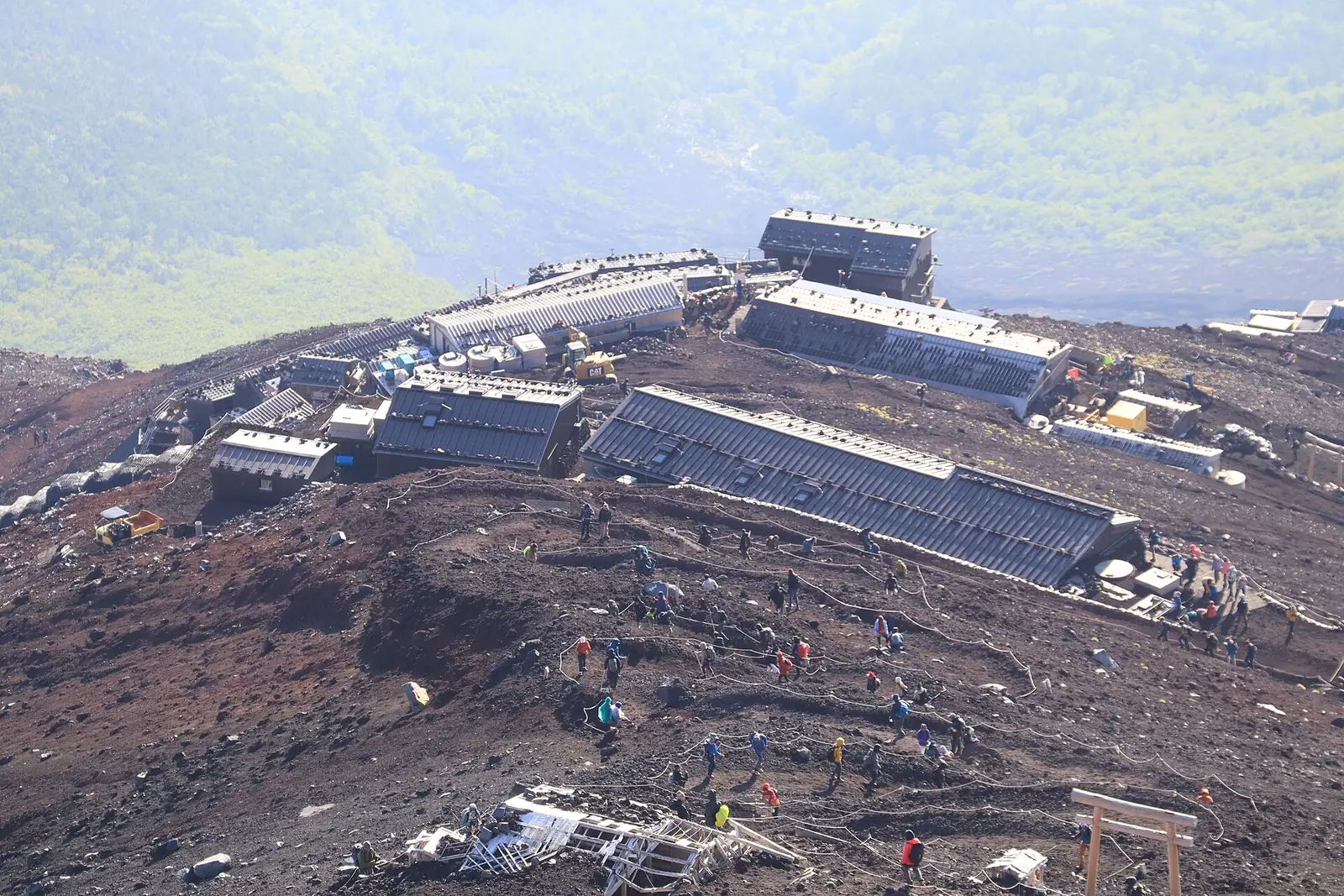
According to the official site, huts are simple facilities for short rests, not hotels.
- Shared sleeping space, generally for both men and women. Bedding is provided.
- No bath, shower, or washing facilities. Water is precious, and drinking water is sold.
- Simple meals for dinner and breakfast. The site says allergies and religious needs may not be accommodated, so ask the hut first or bring your own food. Tomoekan, for example, serves curry for dinner, with a vegetarian option, and gives a bread breakfast pack.
- No trash cans. Take all trash down.
- Check-in matters. You may not be able to use facilities, including meals, after the deadline.
- Wet clothes: Tomoekan says wet bedding does not dry at that altitude and you cannot use it if you are wet, so pack dry clothes in a plastic bag.
Useful items: earplugs, a headlamp, warm layers, 100-yen coins, a power bank, and your own trash bag. The hut-by-hut charging situation varies, so ask.

Altitude Sickness and Safety
The summit is 3,776 m, and the official site says the air pressure near the top is about two-thirds of sea level. Altitude sickness is one of the most common reasons climbers abandon the climb. The official advice:
- Rest 1 to 2 hours near the 5th station before you start.
- Walk slowly and steadily, breathe deeply, and drink often (the site says sports drinks work better than plain water).
- At the hut, spend about an hour unpacking or enjoying the view before you sleep.
- If symptoms appear, descend. The site says that in most cases you recover by descending. "The mountain is not going anywhere."
- If you cannot move, call 110 or 119.
The official site also says falls are the most common cause of accidents, mostly on the descent, and recommends carrying a helmet. Thunderstorms are common in summer. If a warning is issued, turn back.
On bullet climbing, JNTO and the two prefectures say it raises the risk of altitude sickness, hypothermia, crowding near the summit, and falls in the dark. Their advice is to sleep in a hut and keep a relaxed plan.
Getting There
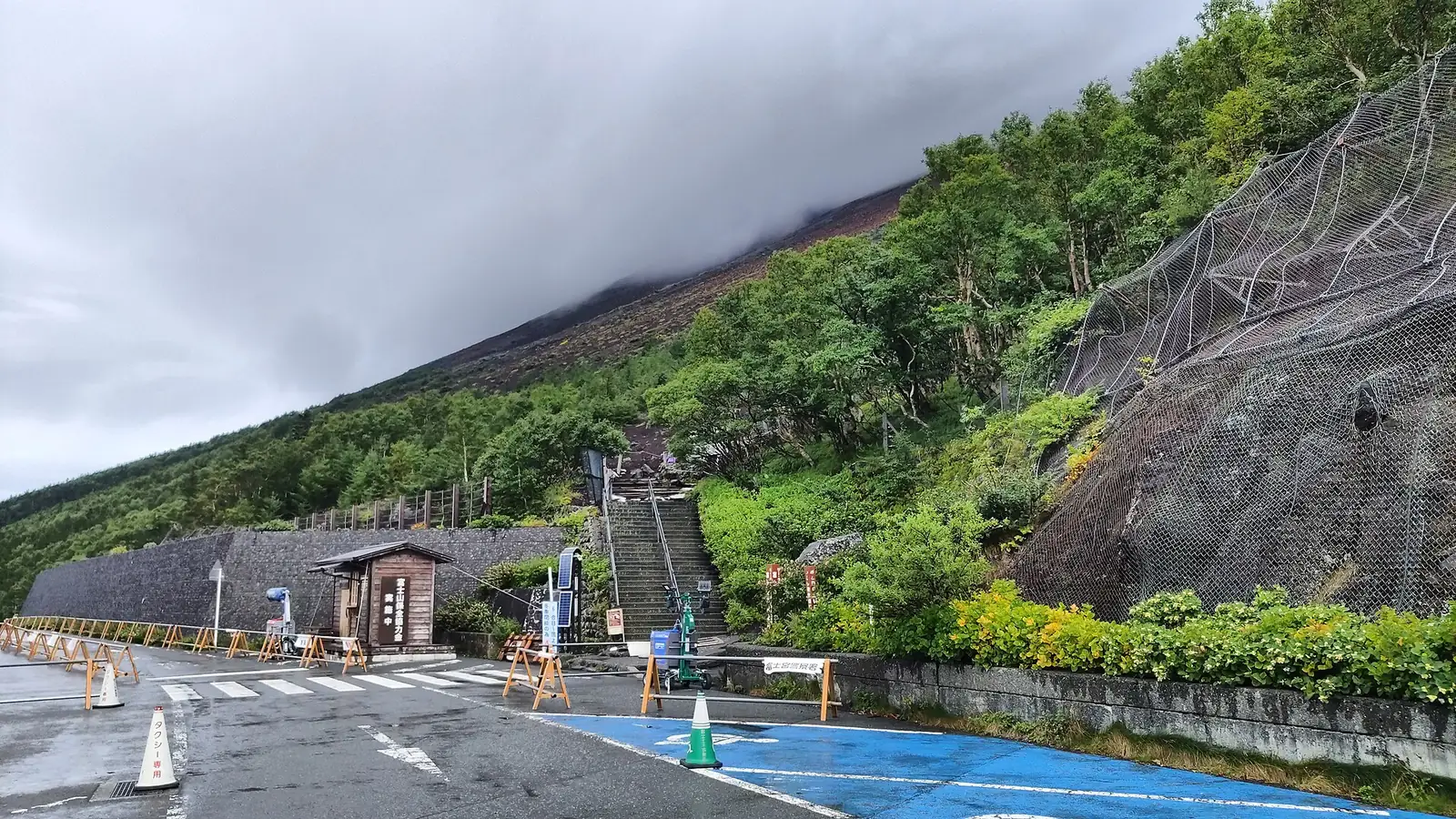
- The official site says there are parking lots at the 5th station of every trail, but private vehicles are restricted at the Fuji-Subaru Line, Subashiri, and Fujinomiya 5th stations in season. Park at the base and use the shuttle bus. Check the prefectural pages.
- Buses do not run late at night and may be full at peak times, so build your plan around the timetable. See Fuji Kyuko for the Yoshida Trail buses.
- Tomoekan's page lists access to the Fuji-Subaru Line 5th Station from Shinjuku Expressway Bus Terminal and from Fujisan Station and Kawaguchiko Station on the Fujikyu Railway.
Do not start right after a long flight. A night in Tokyo or near Fuji before the climb gives you a buffer.

Planning Your 2027 Climb
Season dates, fees, and hut prices for 2027 are not out yet. A sensible order:
- In winter, choose a route and 2 or 3 possible dates. Avoid weekends and public holidays if you can; the official site says late July to late August is crowded, especially on weekends and holidays.
- In spring, watch the official site and your target huts' pages for the reservation opening dates. Some opened as early as spring in 2026, and Tomoekan opened on May 11.
- Book the hut first, then handle the Yamanashi pass reservation or Shizuoka FUJI NAVI.
- Prepare gear: cold-weather clothing, two-piece rain gear, climbing shoes, a headlamp, and cash.
- Leave a day of buffer for weather. If it is stormy, cancel.
FAQ
Can I stay in a hut without a reservation?
Huts operate on an advance-booking system. Do not count on a walk-in bed. Rescue and emergency use are separate.
Can I climb overnight without a hut booking?
Not through the gate between 2 PM and 3 AM. Bullet climbing is discouraged by both prefectures.
Do I need to pay the 4,000 yen fee if I stay in a hut?
Yes. Hut guests also pay the climbing fee, and it can be paid on site.
Do I pay twice if I go up one side and down the other?
No. The official site says you do not pay again, but you may be asked to show proof of payment.
Can children stay?
Children pay the same 4,000 yen climbing fee. Some huts have their own rules for children. Check each hut.
Summary
- The 2026 season ended September 10. Trails above the 5th station are closed until the 2027 season.
- A hut booking lets you pass the Yoshida gate after 2 PM and avoid a bullet climb.
- The climbing fee is 4,000 yen per person, hut guests included.
- Hut booking, payment, and cancellation rules differ by hut. Tomoekan is one example, not the standard.
- Bring cash, dry clothes, earplugs, and a headlamp.
- Altitude sickness: rest near the 5th station, drink often, and descend if symptoms appear.
Official Sources
- Official Website for Mt. Fuji Climbing
- Official site: FAQ
- Official site: 2026 operating periods
- Yamanashi Prefecture notice on the Yoshida Trail (2026)
- Official site: Yoshida Trail huts
- Official site: Fujinomiya Trail huts
- Official site: health and altitude sickness
- Official site: in case of emergency, and climbing outside the season
- JNTO: "Bullet Climbing" notice (PDF)
- Shizuoka FUJI NAVI
- Tomoekan (English)