

Photo: 9689tatsuya, Wikimedia Commons (CC BY 4.0)

15 Autumn-Leaves Day Hikes from Tokyo (2026): When and Where to See Fall Colors in the Kanto Mountains
Fifteen mountains for autumn-leaves day hikes from Tokyo, from the high peaks that turn in late September to the low hills that peak in late November. Includes an elevation-based color calendar, 2026 dates for Mt. Nantai's climbing season and the Mt. Oyama light-up, and late-autumn safety tips.
Updated October 24, 2026. Fall colors shift by one to two weeks from year to year. By late October, the high peaks (around 2,000 m and above) are past their best, and the season moves down to the low mountains around Tokyo. Check each area's latest information before you go.
Autumn is a great time to hike in Japan, and not only for the leaves:
| Why hike in autumn | |
|---|---|
| The colors | Beech, rowan, maple, and Erman's birch turn the mountains another world |
| Clear air | Summer haze lifts and you can see far-off peaks more often |
| Cooler temperatures | Even high mountains are comfortable to walk |
| Fewer bugs and leeches | Insects and mountain leeches drop off sharply from late September |
| Crowds mainly on weekends | Weekdays are quiet |
The leaf season is popular, though, so expect weekend crowds, full parking lots, and early sunsets. Below are 15 mountains by season and area, with when to go, what to see, and how to get there.
Kanto Autumn Leaves Calendar
Colors in the Kanto mountains depend mainly on elevation. Use this as a rough guide.
| When | Elevation (rough) | Example mountains |
|---|---|---|
| Late Sep – early Oct | 2,000 m and above | Nikko-Shirane, Hiuchigatake, Mt. Nasu |
| Early – mid Oct | 1,500–2,000 m | Mt. Tanigawa, Mt. Nantai, Mt. Kentoku, Mt. Akagi (summit) |
| Mid – late Oct | 1,000–1,500 m | Mt. Akagi (lower slopes), Mt. Haruna, Mt. Mitake, Mt. Mitsutoge |
| Late Oct – early Nov | 500–1,000 m | Mt. Buko, Mt. Hinode, Takamizu Sanzan |
| Early – mid Nov | 200–500 m | Mt. Takao, Mt. Jinba, Mt. Oyama (lower slopes) |
| Mid – late Nov | Low hills and lowlands | Mt. Oyama (shrine area and below), Kamakura Alps |
15 Autumn-Leaves Day Hikes
Tochigi and Gunma (High Peaks, Early Colors)
1. Mt. Nasu (Chausudake, 1,915 m)
Typical peak: late September to mid-October
Mt. Nasu in Tochigi is one of the first places near Kanto to change color. A ropeway lifts you up the mountain, so even hikers who are not confident of their fitness can enjoy the views. The bright red berries and leaves of rowan on the rocky slopes near the top, and the yellow birches around the ponds of Ubagadaira, are the classic Nasu autumn scene. The route from Ubagadaira to Hyōtan-ike pond is especially famous, and early-October weekends are busy.
- Difficulty: ★★☆☆☆ (with the ropeway)
- Getting there: bus from JR Nasushiobara Station to the Nasu Ropeway; by car from the Tōhoku Expressway Nasu IC
2. Nikko-Shirane (2,578 m)
Typical peak: late September to early October
The highest peak in Kanto. In late September its slopes turn yellow with Erman's birch, set off by the blue ponds Midagaike and Goshikinuma. The Marunuma Kogen Ropeway takes you up to around 2,000 m. It gets cold quickly from early October, so warm layers and an early start are essential.
- Difficulty: ★★★☆☆
3. Mt. Tanigawa (1,977 m)
Typical peak: early to mid-October
On the Gunma–Niigata border. A ropeway climbs to Tenjindaira (1,319 m). The gradient of red rowan, yellow birch, and golden grass on both sides of the Tenjin Ridge is among the best in the Kanto area. October weekends are very crowded; take the first ropeway of the morning or go on a weekday.
- Difficulty: ★★★☆☆
- Getting there: Jōmō-Kōgen Station (Jōetsu Shinkansen), then a Kan-etsu Kotsu bus to Doai-guchi; by car from the Kan-etsu Expressway Minakami IC


4. Hiuchigatake (2,356 m) and Oze
Typical peak: late September to early October (grass colors from mid-September)
The highest peak in Oze, above the Ozegahara marsh. From mid-September the marsh grasses turn yellow and red, with Hiuchigatake and Mt. Shibutsu behind. From the summit you see the whole of Ozegahara, a carpet of autumn grass dotted with ponds. The Miike trailhead can be reached by public transport.
- Difficulty: ★★★☆☆
- Getting there: Aizu Bus to Miike from Aizu-Kōgen-Ozeguchi Station (Tōbu line)
5. Mt. Nantai (2,486 m)
Typical peak: early to mid-October
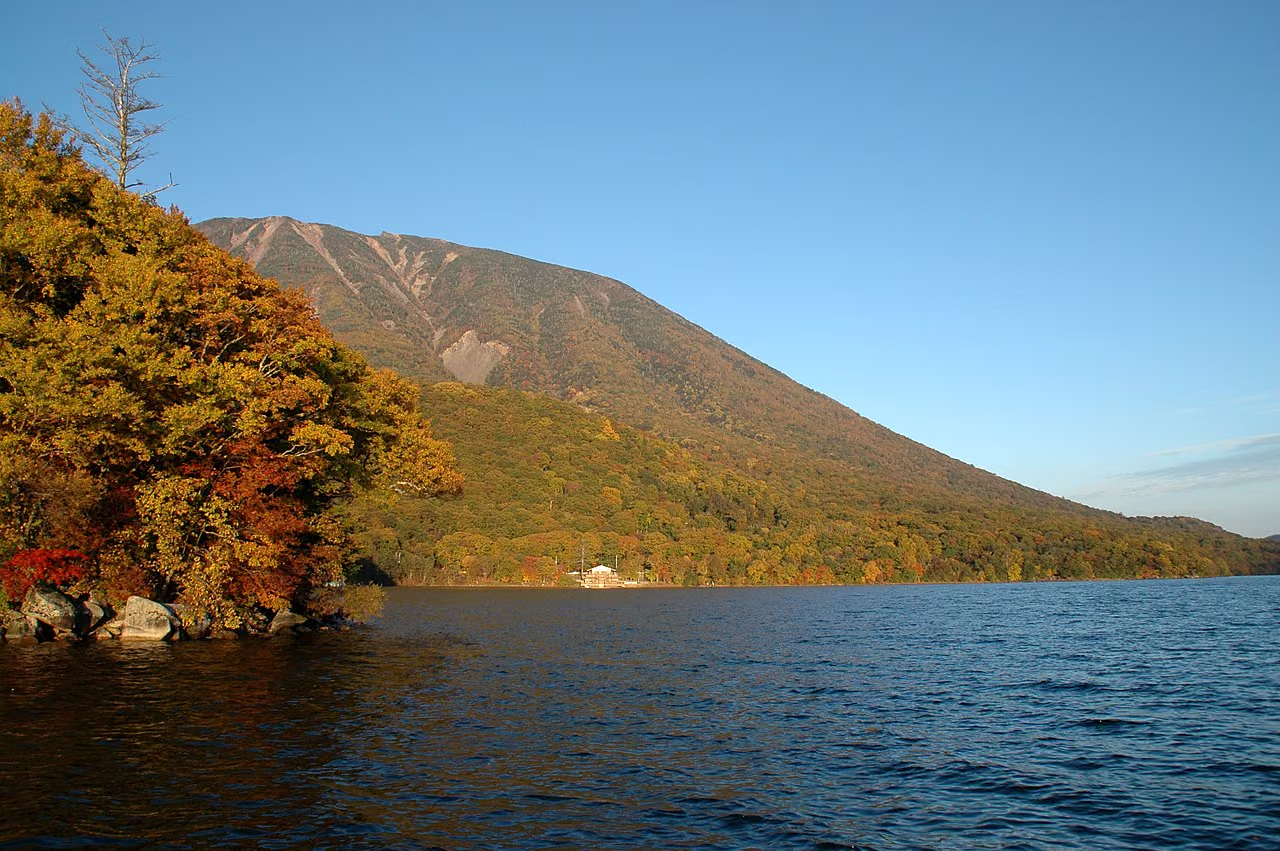
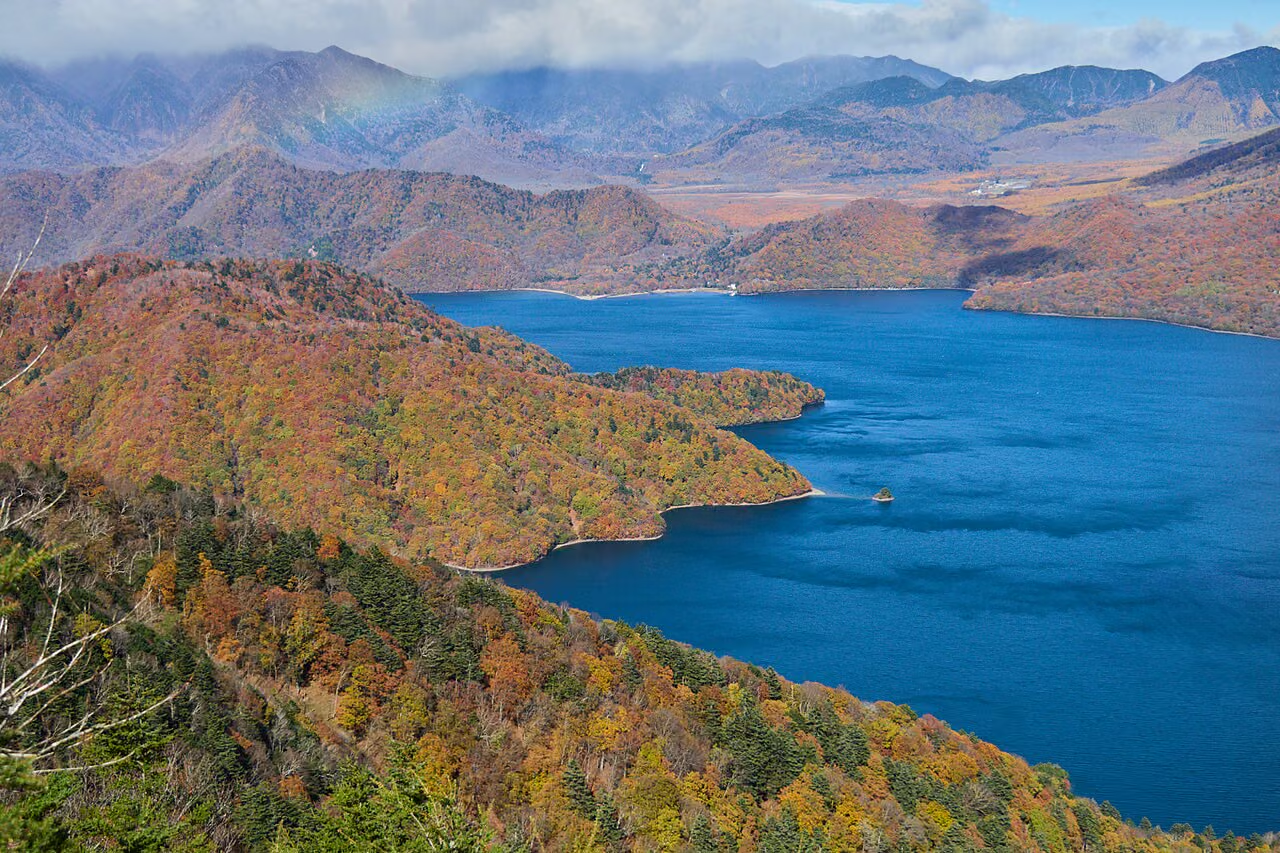
Mt. Nantai in Nikko looks straight down on Lake Chūzenji. You climb about 1,200 m from the lakeside shrine in an almost straight line, but the view of the lake framed by autumn colors is worth it.
The mountain is the sacred body of Nikko Futarasan Shrine. In 2026 the climbing season is April 25 to November 11; outside that period you cannot climb. The gate at Chūgūshi opens at 6:00 and you must register between 6:00 and noon, paying a climbing fee of 1,000 yen (high school age and up; cash only). The shrine gives about 6–7 hours for the round trip, with no water or toilets on the way, and asks hikers to be down by 16:30 while it is light, with a headlamp and bear bell.
- Difficulty: ★★★☆☆ (big height gain and distance)
- Getting there: bus from JR/Tōbu Nikko Station toward Yumoto Onsen, about 55 minutes to Futarasan-jinja Chūgūshi (Nikko City tourism site)


Gunma
6. Mt. Akagi (Mt. Kurobi, 1,828 m)
Typical peak: early to mid-October (summit), mid to late October (lower slopes)
Highland scenery around the crater lakes Ōnuma and Konuma, especially beautiful in autumn. Gunma Prefecture gives about 3 hours 30 minutes for the Mt. Kurobi – Mt. Koma loop. Combine it with a drive around Lake Ōnuma to see Akagi's autumn in a day. Note that the Kakumanbuchi public toilet is closed for now (Gunma, October 1, 2026). See our Mt. Akagi guide.
- Difficulty: ★★☆☆☆
- Getting there: Kan-etsu Kotsu bus from JR Maebashi Station; by car from the Kan-etsu Expressway Maebashi IC
7. Mt. Haruna (Kamongatake, 1,449 m)
Typical peak: mid-October to early November
Several peaks around Lake Haruna. The reflections of maple, oak, and beech in the lake attract many photographers. The trail to Kamongatake is well maintained and short. A ropeway also runs up Haruna-Fuji (check its operating status first), so beginners can enjoy the autumn highlands too.
- Difficulty: ★★☆☆☆ (Kamongatake)
- Getting there: Gunma Bus from JR Takasaki Station to Lake Haruna
Tokyo and Okutama
8. Mt. Mitake (929 m)
Typical peak: late October to mid-November
A cable car takes you up to about 830 m. In autumn the forest turns with maple, zelkova, and oak, and around the Rock Garden fallen leaves pile up on the rocks and moss in a lovely late-autumn scene. The approach to Musashi-Mitake Shrine is colorful too, and you can eat at teahouses in the mountaintop village. It is one of the easiest to reach from central Tokyo, and a perfect first autumn hike.
- Difficulty: ★★☆☆☆ (with the cable car)
- Getting there: JR Ōme Line to Mitake Station, bus to the cable car, then the Mitake-san cable car
9. Mt. Hinode (902 m)
Typical peak: late October to mid-November
Popular as a traverse from Mt. Mitake. The summit opens to the east, famous for sunrise and sunset views. In autumn the whole ridge colors up, and descending to Tsurutsuru Onsen hot spring is the classic finish.
- Difficulty: ★★☆☆☆
- Getting there: start via the Mitake cable car; after the hike, buses run toward Musashi-Itsukaichi Station (JR Itsukaichi Line)
10. Takamizu Sanzan (793 m)
Typical peak: early to mid-November
A traverse of three peaks, Mt. Takamizu (759 m), Mt. Iwatakeishi (793 m), and Mt. Sōgaku (756 m), loved as an introduction to Okutama's autumn. Walking from Ikusabata Station to Mitake Station feels like passing through a corridor of maple and oak. From the top of Mt. Iwatakeishi you look out over colored ridges.
- Difficulty: ★★☆☆☆
- Getting there: start at JR Ikusabata Station, finish at JR Mitake Station (both on the Ōme Line)
Kanagawa
11. Mt. Oyama (1,252 m)
Typical peak: mid to late November (shrine area)
Mt. Oyama in Isehara is known for the maples along the approach to Ōyama-dera temple and the Afuri Shrine lower shrine. The Isehara City Tourist Association says the colors usually peak from mid to late November.
The 2026 light-up runs November 20 (Fri) to November 29 (Sun) at Ōyama-dera and the lower shrine, from sunset to 19:00 on weekdays and to 20:00 on weekends and holidays. The cable car runs late on the same days until the same times. The association warns that weekend parking can involve waits of 2–3 hours, so public transport is a good idea.
From the summit you can see Sagami Bay, the Miura Peninsula, and Enoshima, and Mt. Fuji on clear days. The association gives about 90–120 minutes on foot from the lower shrine to the summit.
- Difficulty: ★★☆☆☆ (with the cable car)
- Getting there: from Isehara Station (Odakyu Line) north exit, platform 4, bus to Ōyama Cable (about 30 minutes), then about 15 minutes on foot to the cable car
Saitama
12. Mt. Buko (1,304 m)
Typical peak: late October to mid-November
Mt. Buko in Chichibu has an unusual shape from limestone quarrying, but the trail on its slopes passes through broadleaf forest of beech, maple, and oak, a tunnel of color in autumn. From the summit you see the Chichibu basin and the Okumusashi and Okutama ranges. The climb from the Ubukawa trailhead (Ichi-no-torii) is for intermediate hikers and up.
- Difficulty: ★★★☆☆
- Getting there: Seibu Line to Yokoze Station, then on foot or by taxi to the Ubukawa trailhead


13. Mt. Bōnoore (969 m)
Typical peak: late October to mid-November
On the Saitama–Tokyo border, famous for its gorge route up the Shiratani stream. In autumn maple, zelkova, and oak color both banks, set against clear water running between the rocks. The route crosses the stream many times and becomes dangerous in rain or high water; go after a spell of dry weather.
- Difficulty: ★★☆☆☆ (stream route)
- Getting there: Seibu Line to Hannō Station, then a Kokusai Kōgyō bus to Sawarabi-no-yu
Tokyo (Takao and Oku-Takao)
14. Mt. Takao to Mt. Jinba Traverse (855 m)
Typical peak: early to mid-November
The Oku-Takao traverse from Mt. Takao (599 m) to Mt. Jinba (855 m) is one of the most accessible and popular autumn hikes in Kanto. The ridge over Mt. Shiro (670 m), Mt. Kagenobu (727 m), and on to Mt. Jinba is lined with maple and oak. Stopping at summit teahouses for nameko mushroom soup or sweet red-bean soup is part of the fun. The usual plan starts at Takaosanguchi Station and ends at the Jinba Kōgen-shita bus stop.
- Difficulty: ★★★☆☆ (a long traverse)
- Getting there: start at Takaosanguchi Station (Keiō Line); from Jinba Kōgen-shita, buses run to JR Takao Station


Yamanashi
15. Mt. Kentoku (2,031 m)
Typical peak: early to mid-October
A varied mountain in Oku-Chichibu with meadows, beech forest, rocky ridges, and chains below the summit. Early to mid-October, when beech and maple between about 1,500 and 2,000 m turn yellow, orange, and red, is its most dramatic time. From the Ōgidaira meadow you look up at colors clinging to the steep rock. The chained sections just below the summit add excitement and a sense of achievement.
- Difficulty: ★★★☆☆ (chains near the summit)
- Getting there: Yamanashi City bus from JR Yamanashishi Station to the Kentoku trailhead (few buses)
At a Glance
| Mountain | Elevation | Typical peak | Difficulty | Highlight |
|---|---|---|---|---|
| Mt. Nasu | 1,915 m | Late Sep – mid Oct | ★★ | Rowan, Ubagadaira |
| Nikko-Shirane | 2,578 m | Late Sep – early Oct | ★★★ | Birch, Goshikinuma |
| Mt. Tanigawa | 1,977 m | Early – mid Oct | ★★★ | Tenjin Ridge |
| Hiuchigatake / Oze | 2,356 m | Late Sep – early Oct | ★★★ | Marsh grasses |
| Mt. Nantai | 2,486 m | Early – mid Oct | ★★★ | Lake Chūzenji (season ends Nov 11) |
| Mt. Akagi | 1,828 m | Early – late Oct | ★★ | Highlands around Ōnuma |
| Mt. Haruna | 1,449 m | Mid Oct – early Nov | ★★ | Lake Haruna reflections |
| Mt. Mitake | 929 m | Late Oct – mid Nov | ★★ | Rock Garden |
| Mt. Hinode | 902 m | Late Oct – mid Nov | ★★ | Traverse from Mitake |
| Takamizu Sanzan | 793 m | Early – mid Nov | ★★ | Okutama ridges |
| Mt. Oyama | 1,252 m | Mid – late Nov | ★★ | Temple approach, light-up Nov 20–29 |
| Mt. Buko | 1,304 m | Late Oct – mid Nov | ★★★ | Beech and maple |
| Mt. Bōnoore | 969 m | Late Oct – mid Nov | ★★ | Stream and leaves |
| Takao – Jinba | 855 m | Early – mid Nov | ★★★ | Classic traverse |
| Mt. Kentoku | 2,031 m | Early – mid Oct | ★★★ | Beech, chains, meadow |
Tips for Autumn-Leaves Hikes
Sunset comes early
Days shorten fast in autumn. Aim to reach the summit by 14:00 and finish by 16:00, and always carry a headlamp, even on a day hike.
Weekend crowds
On peak weekends in October and November, popular mountains such as Takao, Mitake, Oyama, and Nasu are very crowded on trails, cable cars, and parking lots. If you drive, arrive before 7:00 or go on a weekday. Mountains reachable by train are less stressful.
Cold and wind
From October, summit temperatures can fall below 5 °C, and wind on ridges makes it feel colder. Bring a fleece, a light down jacket, and rain gear that doubles as a windbreaker.
Snow and ice above 2,000 m
From mid-October, snow and morning ice can appear on peaks above about 2,000 m (Nikko-Shirane, Hiuchigatake, Mt. Nantai, Mt. Kentoku). Carry light crampons or microspikes just in case, and check snow conditions, not only the forecast. See also bear safety in Japan.
Peak timing changes every year
Peak color moves with temperature and weather. Use forecasts as a guide, and check current conditions on official area sites before choosing your day.
Summary
- Late Sep – early Oct: Mt. Nasu, Hiuchigatake, Nikko-Shirane
- Early – mid Oct: Mt. Tanigawa, Mt. Nantai, Mt. Kentoku, Mt. Akagi
- Late Oct – early Nov: Mt. Mitake, Takamizu Sanzan, Mt. Bōnoore, Mt. Buko
- Early – late Nov: Mt. Oyama, Takao – Jinba, Mt. Hinode
- By train only: Mt. Takao, Mt. Mitake, Mt. Oyama, Mt. Bōnoore, Takamizu Sanzan
- Beginners and families: Mt. Mitake, Mt. Oyama, Mt. Takao (with cable cars or chairlifts)
The two keys to an autumn-leaves hike are catching the right weeks and starting early, finishing early. Enjoy Japan's fall colors in the mountains this autumn.
See also: 22 Hyakumeizan day hikes from Tokyo