

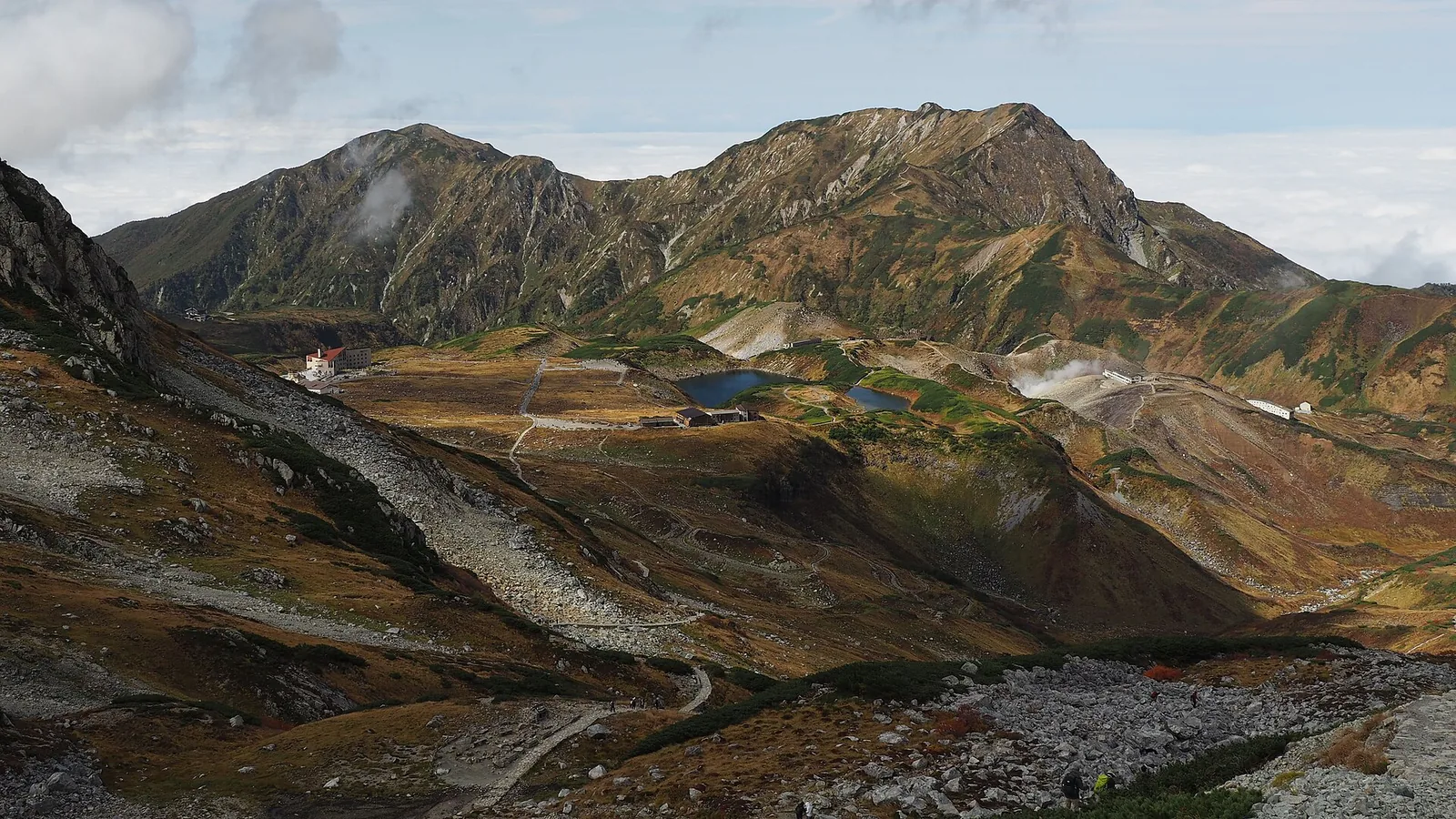
Photo: Alpsdake, Wikimedia Commons (public domain). The Tateyama range seen from Kurobedaira, October 9, 1994.

Tateyama Kurobe Alpine Route in Late Autumn 2026: Which Side to Start, the November Timetable, Tickets, and Murodo Snow Before the November 30 Close
A late-autumn planning guide to the Tateyama Kurobe Alpine Route (立山黒部アルペンルート) before the 2026 season ends on November 30. Choose between a Toyama-side day, a Nagano-side day, or the full traverse; see how the November 4 winter timetable and the November 11 non-stop Highland Bus change your options; and check fares, web tickets, the Alpine-Takayama-Matsumoto Area Tourist Pass cut-off, Murodo snow and clothing, and Kurobe Dam.
This guide is based on the official Tateyama Kurobe Alpine Route website (English and Japanese pages, including the timetables, fares, FAQ, and notices linked below), the Kurobe Dam official site, and the Alpine-Takayama-Matsumoto Area Tourist Pass page. Late-season timetables and ticket rules change with the snow. Check the official timetable and the operating status on the morning you travel.
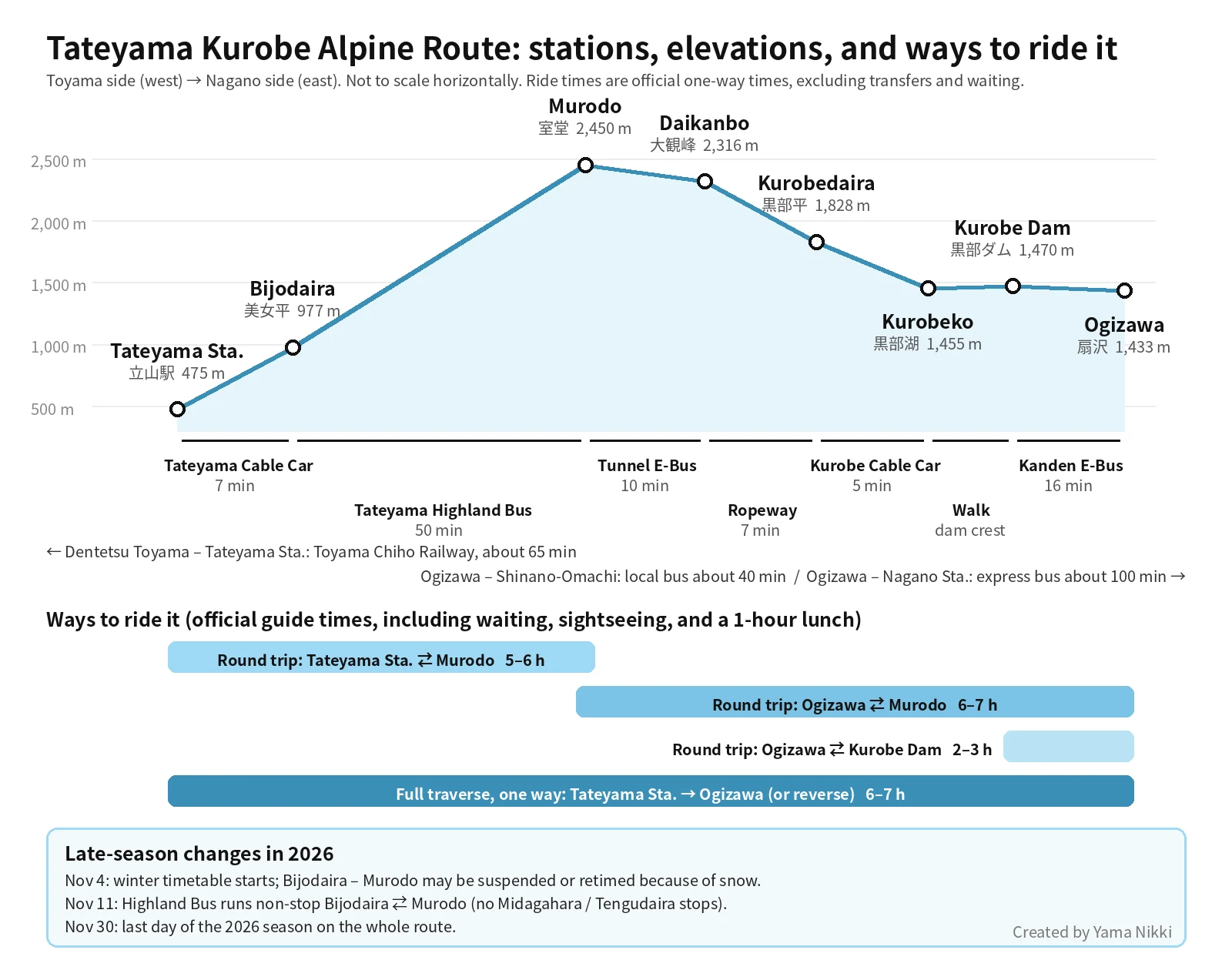
The Tateyama Kurobe Alpine Route (立山黒部アルペンルート) crosses the Northern Japan Alps between Tateyama Station in Toyama and Ogizawa in Nagano. The official site describes it as 37.2 km long with a maximum elevation difference of 1,975 m, almost entirely inside Chubu Sangaku National Park. Private cars cannot drive through; you ride a chain of cable cars, buses, electric buses, and a ropeway instead.
The 2026 season runs from April 15 to November 30. Late autumn is a short, changeable window: the official YUKITABI page points out that in November you can see fresh snow and autumn foliage at the same time, but this is also when the timetable changes, web ticket options shrink, and the mountain road can be hit by snow.
This guide is organized around one question: where should you start, given the date you can go?
Step 1: Pick your plan by traveler type
| Your situation | Best-fit plan | Official guide time | Adult fare (one person) |
|---|---|---|---|
| Staying in Toyama or Kanazawa, returning the same way | Tateyama Sta. ⇄ Murodo round trip | 5–6 hours | 7,380 yen (same-day ticket at Tateyama Sta.) |
| Staying in Nagano, Matsumoto, or Omachi, returning the same way | Ogizawa ⇄ Murodo round trip | 6–7 hours | 12,300 yen |
| Short on time, Nagano side | Ogizawa ⇄ Kurobe Dam round trip | 2–3 hours | Check the fare search |
| Moving between the Japan Sea coast and central Japan | Full traverse, Tateyama Sta. → Ogizawa (or reverse) | 6–7 hours one way | 10,940 yen one way |
| Starting from the city, Toyama side | Dentetsu Toyama → Ogizawa | 7–8 hours | 12,360 yen one way |
Guide times come from the official FAQ and include waiting, sightseeing, and a one-hour lunch. On busy autumn holidays the operator advises adding 1–2 hours. Fares are from the official fare page and the same-day ticket page, which give fares as of February 27, 2026 and note that they may change. Children (6–11) pay roughly half; children under 6 ride free. A traverse is also possible by car if you book a private car forwarding service (see below).
The late-autumn rule of thumb: before November 10, both sides work. From November 11, the Nagano side (Ogizawa) is the easier and more predictable start, because it is the only side where web tickets are still sold and the Ogizawa–Murodo section is less affected by snow on the road.
Step 2: Find your date window (October 13 – November 30)
| Window | What changes | Who it suits |
|---|---|---|
| Until Oct 15 | Last days of the Kurobe Dam observation water discharge (7:00–16:30 from Sep 11 to Oct 15) | Anyone who wants the dam spray |
| Until Nov 3 | Regular timetable. Last Highland Bus from Murodo toward Toyama: 16:20. Last Tunnel Electric Bus from Murodo toward Nagano: 16:30. The operator warns there is no other transport after the last departure | Both sides, including the traverse |
| Nov 4 – Nov 10 | Winter timetable starts. The Bijodaira–Murodo section may be suspended or retimed because of snow. Web tickets are limited to departures from Tateyama Sta. first service–10:40 and Ogizawa first service–13:00. The Highland Bus still stops at Midagahara and Tengudaira | Both sides, with earlier starts |
| Nov 11 – Nov 30 | The Highland Bus runs non-stop between Bijodaira and Murodo. Web tickets are sold only for Ogizawa-side round trips (to Murodo, Daikanbo, Kurobedaira, or Kurobe Dam) and Ogizawa → Kurobe Dam one way, departing Ogizawa first service–13:00. Trips from Tateyama Sta. are same-day tickets only | Mainly Nagano-side round trips |
| Nov 30 | Last day of the 2026 season | — |
Sources: official timetable page, winter timetable PDF, Nov 4–30, notice on the last departures from Murodo, 2026 web ticket notice with the November schedule (Japanese), Kurobe Dam official site.
Key times on the winter timetable (Nov 4–30)
These are from the official winter timetable. Re-check the PDF before you go, because the operator notes that the Bijodaira–Murodo section can change because of snow.
| Direction | First departure | Last through connection |
|---|---|---|
| Tateyama Sta. → Ogizawa | Tateyama Cable Car 8:40 | Tateyama Cable Car 13:50 (arrives Ogizawa 16:51) |
| Ogizawa → Tateyama Sta. | Kanden Tunnel Electric Bus 8:30 | Kanden Tunnel Electric Bus 14:00 (arrives Tateyama Sta. 16:37) |
| Leaving Murodo, either way | — | Tunnel Electric Bus toward Ogizawa 15:30; Highland Bus toward Bijodaira 15:30 |
So on a November day trip, Murodo has to be left by mid-afternoon. For a round trip to Murodo, plan to arrive by late morning so that you have time to walk around before the 15:30 departures.
Step 3: Understand the seven legs
The official Modes of Transportation page lists each vehicle. From west to east:
| Leg (elevation) | Vehicle | Ride time | Notes from the operator |
|---|---|---|---|
| Tateyama Sta. (立山駅, 475 m) → Bijodaira (美女平, 977 m) | Tateyama Cable Car | 7 min | Climbs 502 m at an average gradient of 24° |
| Bijodaira → Murodo (室堂, 2,450 m) | Tateyama Highland Bus | 50 min | 23 km through forest and highland; stops at Midagahara and Tengudaira need a reservation to reboard |
| Murodo → Daikanbo (大観峰, 2,316 m) | Tateyama Tunnel Electric Bus | 10 min | Runs in a tunnel through Mt. Tateyama |
| Daikanbo → Kurobedaira (黒部平, 1,828 m) | Tateyama Ropeway | 7 min | 1.7 km with no pylons along the span |
| Kurobedaira → Kurobeko (黒部湖, 1,455 m) | Kurobe Cable Car | 5 min | Japan’s only fully underground cable car, unaffected by snowfall |
| Kurobeko → Kurobe Dam (黒部ダム, 1,470 m) | Walk | — | Across the top of the dam |
| Kurobe Dam → Ogizawa (扇沢, 1,433 m) | Kanden Tunnel Electric Bus | 16 min | Crosses the Toyama–Nagano border underground |
Beyond the two ends:
- Dentetsu Toyama → Tateyama Sta.: Toyama Chiho Railway, about 65 minutes (official page). Dentetsu Toyama is next to JR Toyama Station. Limited express trains on this line need an extra limited express charge.
- Ogizawa → Shinano-Omachi: local bus, about 40 minutes.
- Ogizawa → Nagano Station: express bus, about 100 minutes. The operator notes that the last express bus to Nagano leaves Ogizawa at 17:00, and that even the first bus from Nagano arrives at Ogizawa at 9:25.
The ride times above do not include transfers. Each leg means getting off, walking through a station, and queuing again, which is why the official guide times are so much longer than the sum of the rides.

Step 4: Tickets and passes
How to buy
| Option | What to know |
|---|---|
| Web ticket (Standard WEB Ticket) | Reserves a departure time on the Tateyama Cable Car from Tateyama Sta. or the Kanden Tunnel Electric Bus from Ogizawa. Buy by 15:00 the day before. You must collect the ticket before boarding. In November the sections and departure times are limited (see Step 2) |
| Same-day ticket | Sold at station counters and valid only on the day of purchase. The Tateyama Sta. counter opens 20 minutes before the first service and the Ogizawa counter 40 minutes before. You choose your departure time from Tateyama Sta. or Ogizawa when you buy. The Dentetsu Toyama counter closes once the winter timetable starts |
| Travel agency vouchers | Exchange for tickets at the station on the day |
Tickets for Tateyama Sta.–Kurobeko and Kurobe Dam–Ogizawa (one way or round trip) are valid for five days, but only if you stay overnight on the route; they are not unlimited-ride passes. At ticket counters you can pay by cash or credit card; the operator says electronic money and QR code payments are not accepted at ticket counters.
Sources: same-day tickets, web ticket notice (Japanese), FAQ (Japanese).
Alpine-Takayama-Matsumoto Area Tourist Pass: ends November 10
The Alpine-Takayama-Matsumoto Area Tourist Pass is a pass for international visitors that covers the whole Alpine Route between Dentetsu Toyama and Shinano-Omachi (including non-reserved seats on Toyama Chiho Railway limited expresses) plus JR lines between Nagoya and Toyama via the Takayama Line and between Shinano-Omachi and Nagoya via the Oito, Shinonoi, and Chuo lines. Check the eligibility rules on the official page before buying.
| Item | Details |
|---|---|
| Price | Adult 24,500 yen / child (6–11) 12,250 yen |
| Validity | 5 consecutive days |
| Last day of use | November 10, 2026 |
| Last day to buy or exchange | November 6, 2026 |
| On the Alpine Route | Show the pass at the Tateyama Sta. or Ogizawa counter to receive a boarding pass for the vehicles between them |
The pass stops being usable 20 days before the route closes. If you travel between November 11 and 30, you need regular tickets.
Step 5: Murodo in late autumn — snow, cold, and what to wear
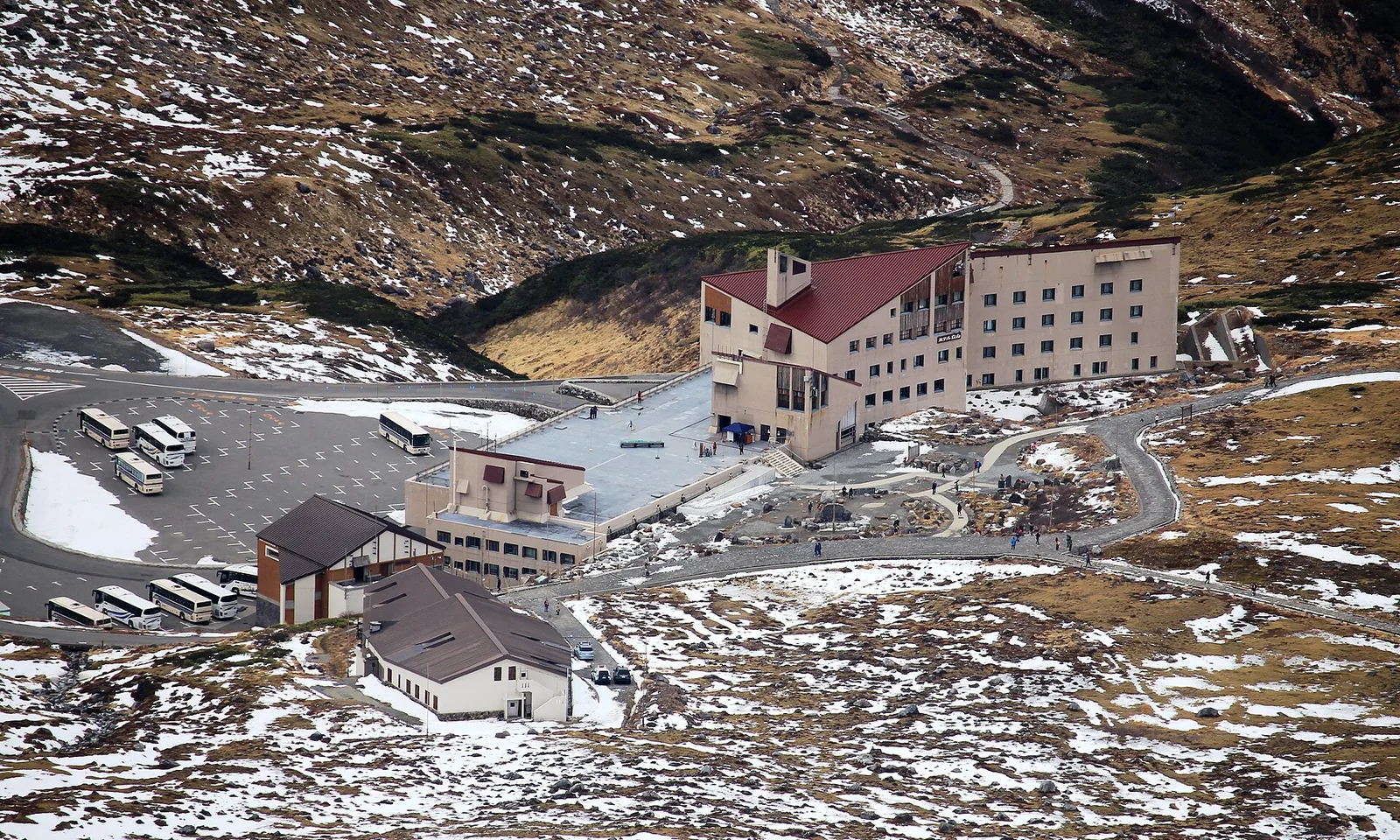
Murodo (室堂, 2,450 m) is the highest station on the route. The official FAQ says it is typically 12–15 °C colder than the lowlands, and colder still in bad weather. Snow usually starts to lie on the Murodo plateau from late October, and from the same time the Highland Bus is prone to delays and cancellations because of snow, ice, and snow clearing on the toll road between Bijodaira and Murodo.
The operator’s clothing advice (Japanese) splits late autumn like this:
| Month | Official description | What to bring |
|---|---|---|
| September–October | Around 10 °C and often chilly; from October, snow flurries are possible around 2,500 m | Thick long sleeves or fleece, windbreaker |
| November | Often below freezing. Vehicles are heated, but it is very cold outside. Even without a walk planned, you may walk on snow, for example on the dam crest | Gloves, hand warmers, scarf or neck warmer, wool hat, sunglasses, and waterproof, non-slip shoes |
In any season, the operator recommends rain gear even on clear days, sneakers rather than leather shoes or heels, a daypack to keep your hands free, and sun protection.
What to see at Murodo
- Mikurigaike Pond (みくりが池): a volcanic crater lake about 15 minutes’ walk from Murodo Terminal, 630 m around and 15 m deep, which the operator calls the deepest lake in the Japan Alps. The first viewpoint is about 5 minutes from the terminal. From mid-October to November, the official Mikurigaike page (Japanese) describes the scenery as white fresh snow and clear air. Ptarmigan live in the surrounding creeping pine.
- Tamadono spring water (玉殿の湧水): usually available from late June to early November (FAQ).
- Weather check: the operator has no route-specific forecast and suggests checking forecasts for eastern Toyama and northern Nagano. Its site posts Murodo and Kurobe Dam conditions twice a day, and you can watch the live cameras.
The rules and etiquette page also notes that the elevation change of up to 2,000 m can cause headaches or ringing in the ears; tell a staff member if you feel unwell. If you plan to climb beyond the walking paths, the same page asks you to submit a hike plan. In November that means winter mountain conditions.

Where the autumn colors are
Because of the elevation range, the colors move downhill through the season. The operator’s typical timing:
| Usual timing | Where |
|---|---|
| Mid-September | Murodo plateau and the 3,000 m main ridge |
| Late September | Daikanbo, Raichozawa, Jodosawa |
| Early October | Around Midagahara and Kurobedaira |
| Mid-October | Kurobe Dam and around Ogizawa |
| Late October | Around Bijodaira and the Hinatayama highland |
| Early November | Around Tateyama Station and Shomyo Falls |
From mid-October on, the pattern is snow up high, colors down low. Timing varies every year; the official site posts foliage updates during the season. From November 1 to 30 the operator also opens a snow play area at Kurobedaira Garden when there is enough snow (YUKITABI page).

Kurobe Dam: what changes after October 15
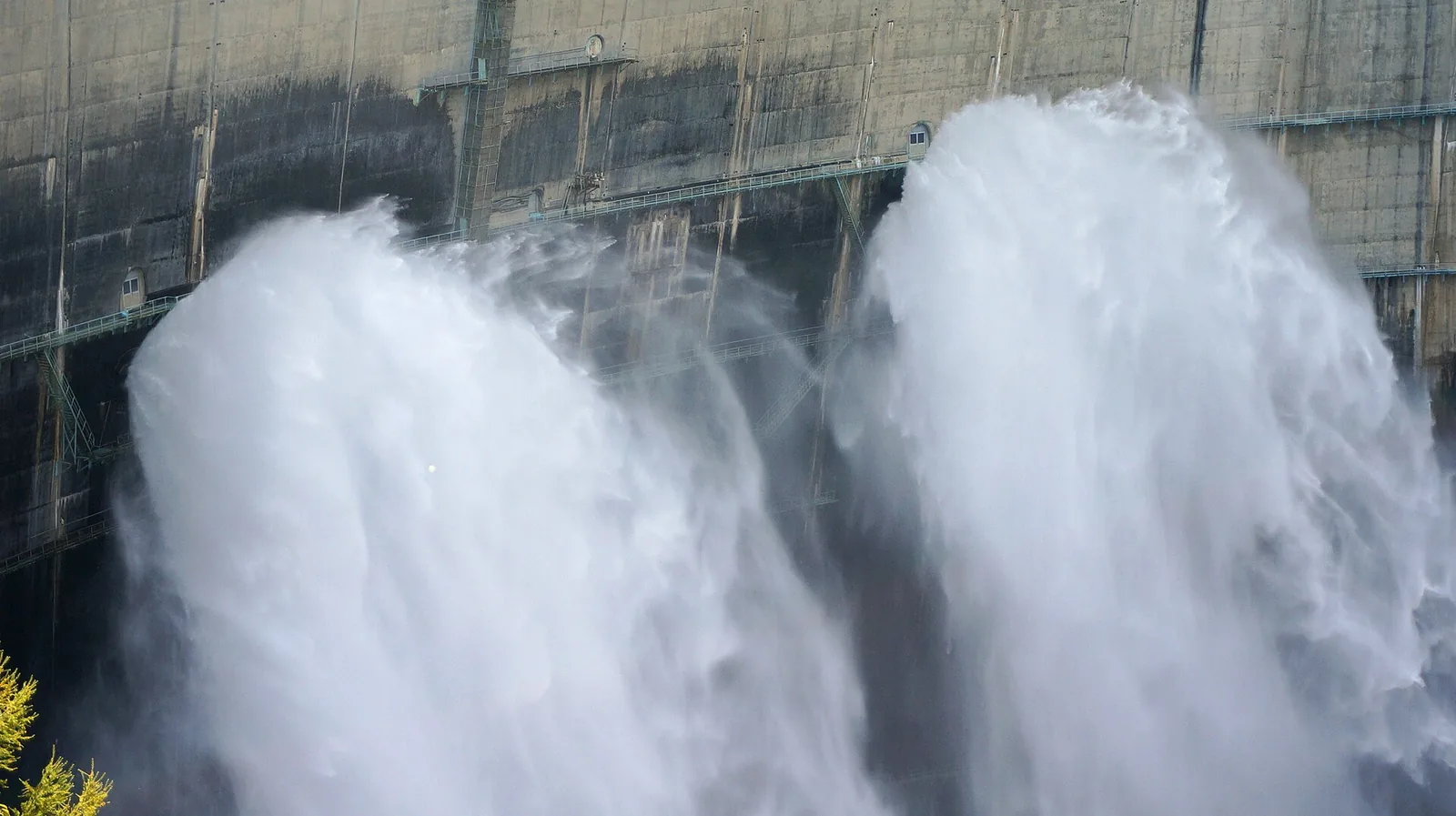
The Kurobe Dam (黒部ダム) observation water discharge runs from June 26 to October 15, continuously from 7:00 to 16:30 between September 11 and October 15, and may be cancelled in bad weather. After October 15 there is no discharge, but you can still walk across the dam, and it is the easiest stop on the route to reach: 16 minutes from Ogizawa on the Kanden Tunnel Electric Bus. From the Toyama side, the Kurobe Dam site puts the trip from Tateyama Station to Kurobeko at about 3 hours 30 minutes.
Sources: Kurobe Dam official site (Japanese), official FAQ.

Getting to the start by car
- Tateyama Station: about 40 minutes from the Tateyama Interchange. About 900 free spaces, plus about 600 free temporary spaces at peak times (parking page).
- Ogizawa: about 60 minutes from the Azumino Interchange and 30 minutes from central Omachi. 230 free and 350 paid spaces; paid lots cost 1,000 yen for up to 12 hours, and the machines accept only 1,000-yen bills. At peak times you may be sent to a temporary lot about 8 km before Ogizawa (1,000 yen per car, with a free shuttle bus).
- Tires: from late October, roads to Tateyama Station and Ogizawa can have snow or ice depending on cold air. The operator recommends winter (studless) tires or carrying chains (FAQ).
- Traversing with a car: several private companies offer car forwarding between Tateyama Station and Ogizawa from late April to November. The official page says it takes about five hours, needs a reservation and deposit, and excludes fuel and tolls (baggage and car forwarding, Japanese).
Practical tips before you go
- Bring cash in advance. There are no ATMs on the route. The operator points to convenience stores near Tateyama Station and Ogizawa. Most restaurants and shops accept cards, e-money, and QR payments, but some are cash only.
- Baggage forwarding ends November 8. The same-day service between Dentetsu Toyama and Shinano-Omachi (and listed hotels) costs 4,000 yen per item, cash only, and runs April 15 to November 8, 2026 (baggage forwarding). After that, plan to carry your bags or use coin lockers at Tateyama, Bijodaira, Midagahara, Murodo, Kurobe Dam, and Ogizawa. The staffed baggage storage at Murodo has ended.
- No pets, no drones. Pets are not allowed on the route, not even in carriers, and drones should not be flown around stations, hotels, and other facilities (FAQ, rules and etiquette).
- Food and water. You can bring your own food, but take all leftovers and trash home. There are four water points: in front of Tateyama Station, the Murodo plateau, Kurobedaira, and Kurobe Dam.
- Do not miss the last connection. In November, the last through departures are early afternoon (Step 2). Missed connections with Toyama Chiho Railway, buses, or JR are not refunded, so leave a margin.
Related guides on this site
- Kamikōchi day trip 2026: bus reservations, access, and valley walks — another car-free valley in the Northern Japan Alps, reached from Matsumoto.
- Japan hiking rules basics — read this if you plan to walk beyond the Murodo paths.
- Bear safety while hiking in Japan — useful for walks at lower elevations on either side of the route.
References
- Tateyama Kurobe Alpine Route — official site (English)
- Timetable (English) / Winter timetable PDF, Nov 4–30, 2026
- Notice: last departures from Murodo (16:20 toward Toyama, 16:30 toward Nagano) (Japanese)
- 2026 Standard WEB Ticket, including the November schedule (Japanese)
- Same-day tickets (English)
- Fares and fare search (Japanese)
- Modes of Transportation (English)
- Parking (English)
- Baggage forwarding (English) / Baggage and car forwarding (Japanese)
- FAQ (Japanese)
- Clothing and packing advice (Japanese)
- Mikurigaike Pond (Japanese)
- YUKITABI late-season events (English)
- Rules and etiquette (English)
- Live cameras (English)
- Kurobe Dam official site (Japanese)
- Alpine-Takayama-Matsumoto Area Tourist Pass (English)