
Photo: Vyacheslav Argenberg, Wikimedia Commons (CC BY 4.0)

What Color Should Hiking Clothes Be? Bright Colors, Black Clothing, Rain Gear, Hornets and Hunting Season in Japan
Why is hiking gear so brightly colored, and which colors stand out best in the mountains? Background-by-background color tips, whether black clothing is a problem, rain gear colors, and why white is recommended against hornets in summer but risky in hunting season, based on guidance from Japanese prefectural police and local governments.
This guide is based on safety advice from Japanese prefectural police, local governments, the Ministry of the Environment and the Forestry Agency, checked October 24, 2026. Most linked pages are in Japanese.
Walk into a Japanese outdoor shop and much of the clothing is neon yellow, orange or bright blue. Next to everyday clothes, it can look loud or even a bit odd.
Here is the short answer:
- Make the outer layers (rain jacket, hat, pack cover) a bright color such as red, orange or yellow.
- Black clothing is not forbidden, but avoid going head to toe in black or earth tones.
- White depends on the season. In the hornet season from summer to autumn, whitish clothing is recommended; in hunting season, a white towel is considered dangerous.
Yamaguchi Prefectural Police state that choosing loud colors is "the golden rule," noting that warm colors such as red, yellow and orange stand out even in a forest, and fluorescent colors even more so. The rest of this guide explains why, and how to pick colors for different situations.
Bright colors are there so you can be found
Mountain backgrounds are made of natural colors: the green of trees, the brown of trunks and soil, the gray of rock, the white of snow. Black, khaki, brown and dark gray look calm, but they blend into these backgrounds easily.
Ishikawa Prefectural Police point out that when a rescue helicopter is sent out, hikers can often see the helicopter, but the crew can hardly see the hikers from above. They ask hikers to avoid clothing in the same colors as the surroundings.
Bright colors help in situations like these:
- When fog, rain or dusk reduces visibility
- When you get lost, or fall and cannot move
- When your group spreads out and you need to spot the person behind you
- When you are looking for companions on a crowded summit or a popular autumn-leaves trail
In other words, a bright color is less a matter of taste and more a piece of safety gear that works the whole time you wear it.


Which colors stand out? A guide by background
There is no single color that always works. The color that stands out is the one that contrasts with that day's background. As a rough guide:
| Background | Colors that stand out | Colors that blend in |
|---|---|---|
| Summer forest (green, brown) | Red, orange, pink, bright yellow | Dark green, khaki, brown, black |
| Rock, fog, cloudy sky (gray) | Yellow, orange, red, bright blue | Gray, black (easily mistaken for shadow) |
| Autumn leaves (red, yellow, brown) | Bright blue, turquoise, yellow-green | Red, orange, brown (can get close to the background) |
| Snow (white) | Red, orange, yellow, dark blue | White, pale gray (merge with the snow) |
If in doubt, red, orange or yellow will contrast with the background in most situations.
What color should rain gear be?
Rain gear is where color matters most. The reason is simple: it is the outermost layer you wear exactly when visibility is poor and you are most likely to get cold, in rain, fog or strong wind. On those days, a black, navy or khaki rain suit blends into the scenery.
Some guidelines:
- If in doubt, red, orange or yellow: these contrast well in forest, on rock and on snow
- If you choose blue, go bright: navy is close to a dark color and hard to see in rain or at dusk
- If the jacket and pants differ, make the jacket the brighter one: from a distance, people see your upper body and pack
- Mix colors within a group: if everyone wears the same color, it is hard to tell who is where
On rainy days you will usually put a cover over your pack, so a brightly colored pack cover makes you visible from behind.


Is it bad to hike in black?
There is no need to say black clothing is off-limits. Plenty of hikers wear black pants or base layers. What to watch out for is dressing entirely in black and having a black outer layer.
- Harder to spot: in forest, in the shade of rocks or in fog, black easily looks like a shadow
- More likely to draw hornets: a leaflet from Japan's Forestry and Forest Products Research Institute says hornets ready to attack go for black objects first, and recommends white or yellow clothing and hats
If you like black or navy, making at least one of your rain jacket, hat or pack cover a bright color goes a long way toward making up for it.
Colors by season: hornets, autumn leaves, hunting season and snow
This is the part people often miss: white is good in one season and risky in another.
Summer to autumn: whitish clothing against hornets
Sagamihara City warns that hornets and similar insects become aggressive from August to October, and asks people to avoid dark clothing and wear white hats and long sleeves. Nagano City likewise advises whitish clothing outdoors, and especially a white-type hat on your head. Both also ask you to avoid strong smells such as perfume and hair products.
Autumn-leaves season: red and orange get close to the background
On mountains in autumn color, a red or orange jacket can come close to the color of the background. In this season it helps to carry one item in a color different from the leaves, such as yellow, bright blue or turquoise.
Late autumn to winter: no white towels or camouflage in hunting season
According to Japan's Ministry of the Environment, the hunting season is in principle November 15 to February 15 outside Hokkaido, and October 1 to January 31 in Hokkaido. (Designated hunting areas have different periods, and prefectures may extend or shorten the season for some species.)
For this period, Fujinomiya City asks people entering the forest to wear conspicuous colors so hunters can see them, and warns that white, including a towel around your neck, is the same color as a deer's rump and is very dangerous because hunters may mistake you for one. It also asks you to avoid camouflage. The Hokkaido Regional Forest Office similarly asks people entering forests during the hunting period to wear clothing that is clearly visible to hunters, such as red or orange, and to avoid camouflage in particular.
So the same color flips: "white against hornets" in summer, "no white towels" in hunting season. From late autumn on, sticking to red, orange and yellow keeps you clear of both warnings.
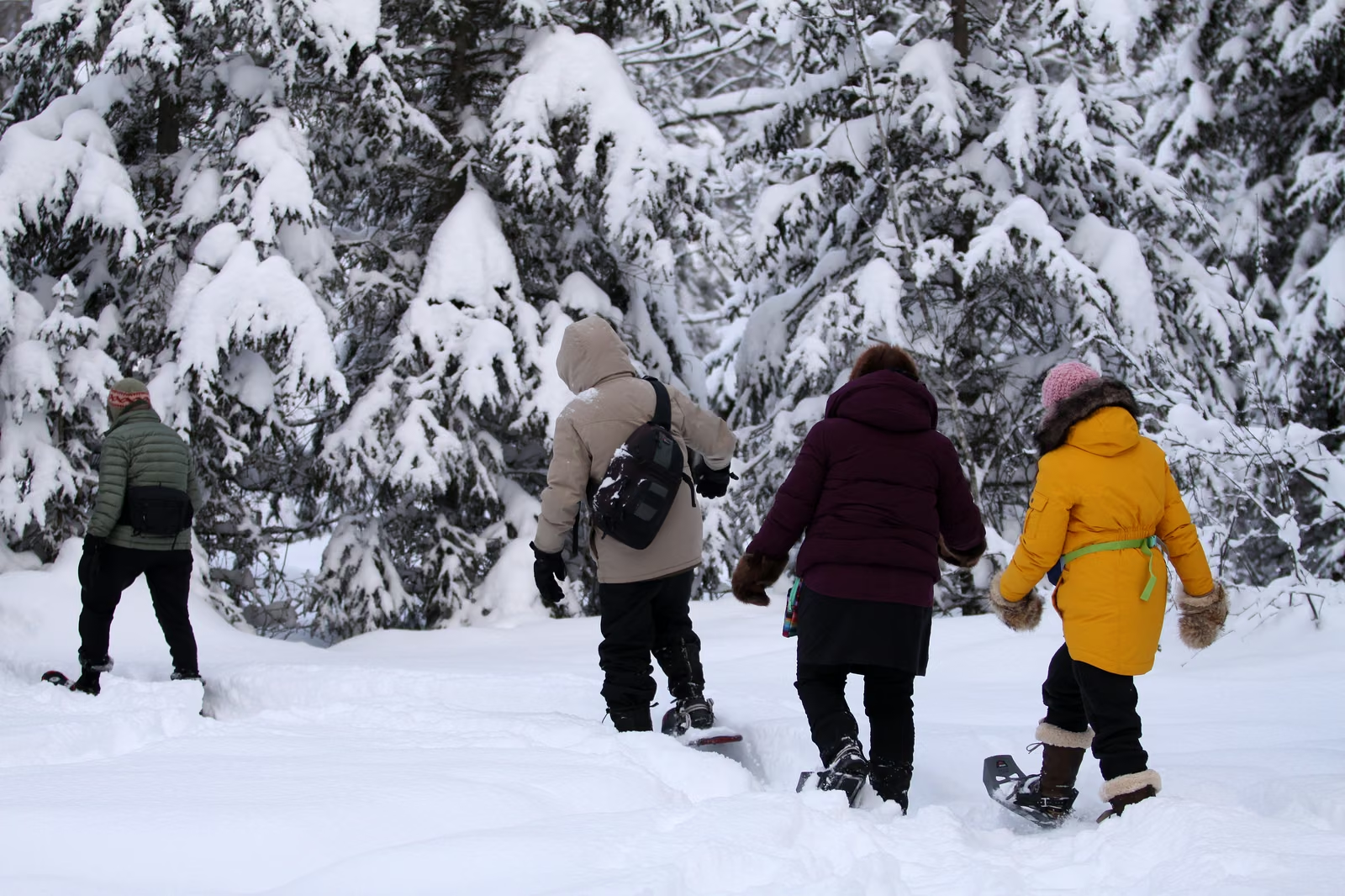
Snow: white and pale colors merge with the snow
On snow, white or light gray clothing disappears into the background. In winter and when snow remains in spring, the basic rule is to wear an outer layer in a color that contrasts with white, such as red, orange, yellow or dark blue.

Clothing color and bears
People often ask whether bright colors keep bears away. In short:
- The basics of avoiding bear encounters are letting them know you are there with bells, your voice or a radio, checking sighting reports, and managing food and trash
- Bright colors help other hikers and rescuers notice you, but clothing color will not keep bears away
- It is also not as simple as "black clothing attracts bears." The real issues with black are the ones above: hornets and being hard to find
For bears, see our bear safety guide for hiking in Japan.
Where to put bright colors first
You do not need to go fluorescent from head to toe. It is most efficient to start with items that cover a large visible area or that you wear in bad weather.
| Priority | Item | Why make it bright |
|---|---|---|
| 1 | Rain jacket | Your outermost layer in bad weather; helps most with being found and not getting separated |
| 2 | Pack cover | Makes you visible from behind on rainy days, and easy to find in a crowd |
| 3 | Hat | Small, but the head is where people tend to look |
| 4 | Warm layer or wind shell | Stands out when you put it on during breaks, on summits and ridges |
| 5 | Gloves, stuff sacks, emergency shelter | Easier to find if dropped, and easier to find inside your pack |
A jacket you also wear in town can stay navy or gray; just making your rain gear and hat orange is enough.
In an emergency, color becomes a signal
If you are lost or injured and waiting for rescue, brightly colored items can also be used as a signal. Gunma Prefectural Police advise that, to ask a helicopter for help, you move to an open place with a good view and wave something large that stands out from the surroundings, such as rain gear, a tent or a towel, and point reflections from a mirror or the light of a camera flash toward the helicopter. Ishikawa Prefectural Police also recommend spreading out anything shiny, such as an emergency blanket.
A bright rain jacket, emergency shelter or emergency blanket is itself a marker.


FAQ
My only rain jacket is black. Should I replace it?
No need to rush. Start by making your pack cover and hat bright to cover the parts others see. Then choose a bright color the next time you buy rain gear.
Does it have to be fluorescent?
No. Colors that contrast with the background, such as red, orange or yellow, work even if they are not fluorescent. Yamaguchi Prefectural Police note that warm colors stand out in the forest and fluorescent colors stand out even more.
I feel out of place wearing these colors in town
Towns are full of gray and black buildings and roads, so bright colors pop. In the mountains, against green, rock or snow, the colors that look loud in town are just visible enough. One option is to keep town clothes in calm colors and keep bright rain gear and hats for the mountains.
Summary
- Hiking clothes are bright so you can be found in the mountains. Prefectural police ask hikers to choose loud colors and avoid colors that match the surroundings
- As a rule, red, orange and yellow stand out. In autumn-leaves season, add yellow or bright blue; on snow, anything but white
- Black is not forbidden, but make the outer layers (rain jacket, hat, pack cover) bright
- White depends on the season: whitish clothing against hornets from summer to autumn; no white towels or camouflage in hunting season
- The basics of avoiding bears are sound and information. Clothing color alone will not keep bears away
- Color alone does not make you safe. Prepare it together with a hiking plan, a map, a headlamp, a means of communication, rain gear and warm layers
References
- Yamaguchi Prefectural Police: for safe and enjoyable hiking (Japanese)
- Ishikawa Prefectural Police: mountain rescue team, advice for hikers (Japanese)
- Gunma Prefectural Police: what to do in an emergency (Japanese)
- Forestry and Forest Products Research Institute: preventing hornet stings in forest recreation (Japanese, PDF)
- Sagamihara City: cautions when walking in green spaces (Japanese)
- Nagano City: hornet precautions (Japanese)
- Ministry of the Environment: overview of the hunting system (Japanese)
- Fujinomiya City: for people working or hiking in the forest (Japanese)
- Hokkaido Regional Forest Office: cautions during the hunting period (Japanese)