

Photo: Kusunose via Wikimedia Commons (CC BY-SA 4.0)
Sleeping in Your Car at Late-Autumn Trailheads: How to Stay Warm with Window Insulation, Mats, Sleeping Bags & Condensation Control
A practical guide to staying warm and safe when sleeping in your car at high-elevation trailheads in October and November—covering JAF cabin-cooling tests, window shades, R-value sleeping mats, EN/ISO sleeping bag ratings, condensation control, and carbon monoxide safety.
Sleeping in your car the night before a hike (zenpaku / trailhead car camping) is one of the best ways to secure a parking spot and hit the trail at dawn. However, in late autumn (October and November), many hikers underestimate just how brutally cold a parked car becomes overnight at a mountain trailhead—waking up shivering at 3:00 AM and starting a long climb exhausted and sleep-deprived.
Unlike an insulated house, an automobile cabin is surrounded by thin sheet metal and large panes of glass. Once you turn off the engine, the temperature inside the car drops rapidly toward the outside air temperature. Here is how to build a warm, safe, condensation-free sleeping system for late-autumn trailhead nights using official test data and mountain gear standards.
1. Why a Parked Car Gets Freezing Cold in Late Autumn
Elevation Lapse Rate + Radiative Cooling at 1,500 m Trailheads
According to the Japan Meteorological Agency (JMA), air temperature drops by roughly 0.65°C for every 100 meters of elevation gain (about 9.8°C at 1,500 meters). Even if the forecast for a lowland city is a mild 10°C overnight, a trailhead parking lot at 1,500 meters—such as Kamikochi/Sawando, Yatsugatake (akadake-kosen/minoto), Mt. Tanigawa, or Nasu ( Oku-Nasu)—will easily drop to 0°C or below freezing before dawn, especially on clear, windless nights when radiative cooling is strongest (Nagano Prefecture Autumn Mountain Safety Leaflet PDF).

What JAF's Winter Cabin-Cooling Tests Show
In winter vehicle tests conducted by the Japan Automobile Federation (JAF) under an outside temperature of -9.2°C to -10.2°C (JAF Winter Cabin Temperature User Test):
- Once the engine heater was switched off at a cozy 25.0°C, the cabin temperature plummeted to 8.5°C within just 1 hour, reached 0°C after about 2 hours 45 minutes, and fell to -6.5°C by morning.
- Meanwhile, in a test comparing sleeping aids inside an unheated car (JAF Snowbound Cabin Environment Test), layering a thermal blanket, down jacket, and insulating floor sheet/mat kept the temperature inside the bedding around 15–25°C even after the cabin air dropped below freezing.
2. Never Rely on Idling or Gas Stoves Inside a Car
When the cabin turns icy, it is tempting to leave the engine idling with the heater on or light a compact hiking stove inside the vehicle. Both practices carry fatal risks:
| Hazard | Official Findings & Safety Rule | Official Reference |
|---|---|---|
| Engine Idling in Snow or Wind (CO Poisoning) | If drifting snow or a snowbank blocks the exhaust tailpipe even partially, odorless carbon monoxide (CO) backs up into the cabin through body seams and air intakes. In JAF's experiment, CO levels inside a snow-banked idling car exceeded 400 ppm within 18 minutes and 1,000 ppm within 22 minutes—levels that cause unconsciousness and death. | JAF Carbon Monoxide Poisoning Test & JAF Snow Driving FAQ |
| Using Gas Burners or Charcoal Stoves Inside a Car | Burning any fuel (OD/CB gas canisters, kerosene, or charcoal) inside a small, enclosed vehicle rapidly consumes oxygen, generates lethal concentrations of CO, and creates an extreme fire hazard near sleeping bags and synthetic upholstery. Never cook or heat with combustion appliances inside a vehicle. | MHLW Carbon Monoxide Poisoning Warning & NITE Gas Appliance Safety Alert PDF |
3. The 4-Layer System to Beat Car-Camping Cold Without Running the Engine
Heat escapes from your body inside a parked car through three primary pathways:
- Radiation & Convection from Windows (窓ガラスからの冷気): Cold glass chills the surrounding air, which sinks directly onto your face and shoulders (cold draft).
- Conduction from the Vehicle Floor (床面からの底冷え): Cold air pooling under the chassis cools the floor metal, and compressed car seats create gaps and pressure points that drain body heat from below.
- Sleeping Bag Rating Mismatch & Dampness (寝袋の保温力不足・結露濡れ): Using a summer sleeping bag or letting window condensation soak the footbox ruins loft.
Here is how to block each pathway step by step:
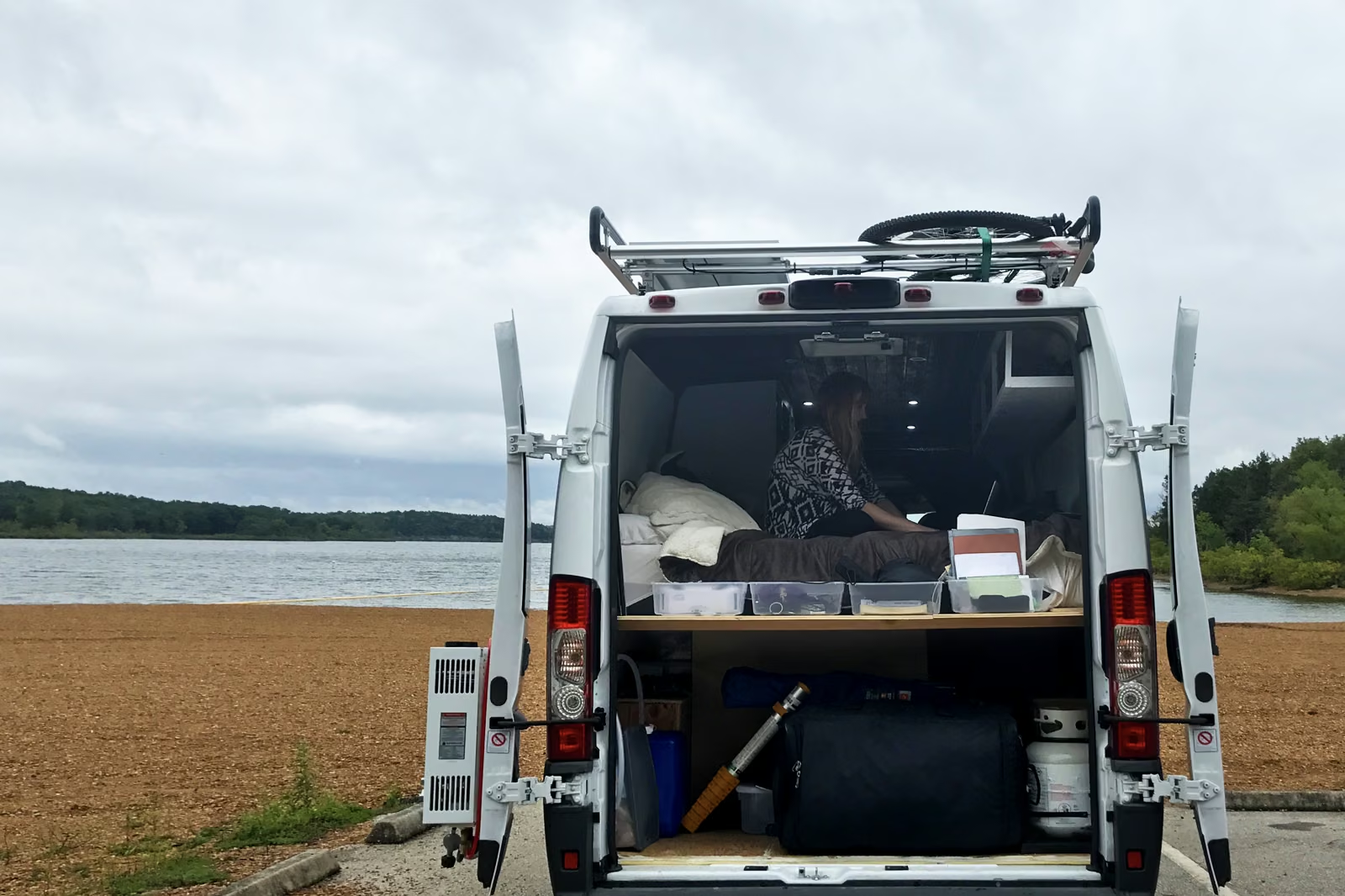
Layer 1: Cover Every Window to Stop Cold Drafts
- Fit insulated multi-layer window shades (マルチシェード) or cut aluminum-backed foam mats / corrugated plastic boards (danpla) to cover the windshield, rear window, and all side windows.
- Even hanging a thick fleece blanket or emergency thermal sheet across the windows traps a dead-air layer and drastically reduces the cold draft pouring down onto your face.
Layer 2: Level the Seats and Stack Sleeping Mats (Target Total R-Value ≥ 4.0)
- Fill Seat Steps First: Folded car seats almost always leave ridges, steps, or seatbelt-buckle bumps. Stuff spare clothes, towels, or gear bags into the hollows first so your back lies completely flat (MHLW Disaster Vehicle-Evacuation Guide PDF).
- Double Up Your Mats: Lay a closed-cell foam mat (or silver insulated leisure mat) across the car floor/seats as a base, and place an inflatable / urethane camping mat on top. For sub-zero trailhead nights, aim for a combined ASTM R-value of 4.0 or higher beneath your sleeping bag.
Layer 3: Choose a 3-Season / Winter Sleeping Bag Rated for -5°C to 0°C Comfort
- Check the ISO 23537 / EN 13537 temperature ratings on your sleeping bag (Montbell Sleeping Bag Temperature Guide):
- Comfort Temperature (コンフォート温度): The temperature at which a standard sleeper (or cold sleeper) can sleep comfortably in a relaxed posture.
- Limit Temperature (リミット温度): The lower limit at which a warm sleeper curled up can sleep for 8 hours without waking from cold.
- For late-autumn trailheads at 1,000–1,800 meters (where cabin temps drop to -5°C to +2°C), a summer bag (#3 or higher) is not enough on its own. Choose a 3-season/winter bag with a Comfort rating around 0°C to -5°C (such as a Montbell #1 or #2 class bag; e.g., Down Hugger 800 #2), or boost a #3 bag by adding a sleeping bag liner, an over-blanket, and a down jacket/down pants.
Layer 4: Put a "Hot Water Bottle" (Yutanpo) at Your Feet
- Boil water outside the car (in a safe spot away from dry grass and vehicles) before going to bed, pour it into a heat-resistant Nalgene Tritan bottle (or metal yutanpo), wrap it in a thick wool sock or towel to prevent low-temperature burns, and place it inside the footbox of your sleeping bag 15 minutes before climbing in. It stays warm until morning—and the lukewarm water inside can be used for washing up or making morning coffee!
4. How to Control Heavy Window Condensation Inside the Car

An adult exhales and perspires roughly 300 to 500 ml of water vapor over a single night. In a tightly shut car, that moisture condenses on cold windows and metal panels—dripping onto the footbox of your down sleeping bag and freezing the inside of the windshield so you cannot drive away promptly in the morning.
- Insulate the Glass: Window shades keep warm, humid cabin air from directly touching ice-cold glass.
- Crack Two Opposite Windows by 5–10 mm (If Wind Permits): Leaving a tiny 5–10 mm cross-ventilation gap under the rain visors allows humid air to escape without creating a strong draft.
- Keep Your Down Sleeping Bag Away from Bare Glass & Metal Doors: Drape a waterproof rain jacket or sleeping bag cover over the foot end of your bag so it never brushes against wet door panels or the rear hatch window.
- Keep a Microfiber Towel & Defroster Scraper Within Reach: Wipe down the windshield before starting out.
5. Late-Autumn Trailhead Parking Etiquette & Early-Freeze Road Checks
- Follow Road Station (Michi-no-Eki) and Trailhead Rules: Japan's Ministry of Land, Infrastructure, Transport and Tourism (MLIT) reminds drivers that Michi-no-Eki rest areas are designed for short rest breaks to prevent drowsy driving, not for setting up camp chairs, awnings, or outdoor cooking in parking spaces (MLIT Michi-no-Eki Rest vs. Lodging Guidance & MLIT Parking Usage FAQ). Keep all gear inside your vehicle, turn off headlights and engines promptly so you do not disturb neighboring hikers, and pack out 100% of your trash.
- Check Tire Requirements & Battery Health Before High-Pass Drives: In late October and November, mountain passes above 1,200 meters can experience sudden black ice or early snow (JAF Summer Tires on Snow Test), and cold temperatures reduce 12V lead-acid car battery performance (JAF Winter Battery FAQ). Charge phones and headlamps from a portable power bank, never from the car's accessory socket with the engine off.