
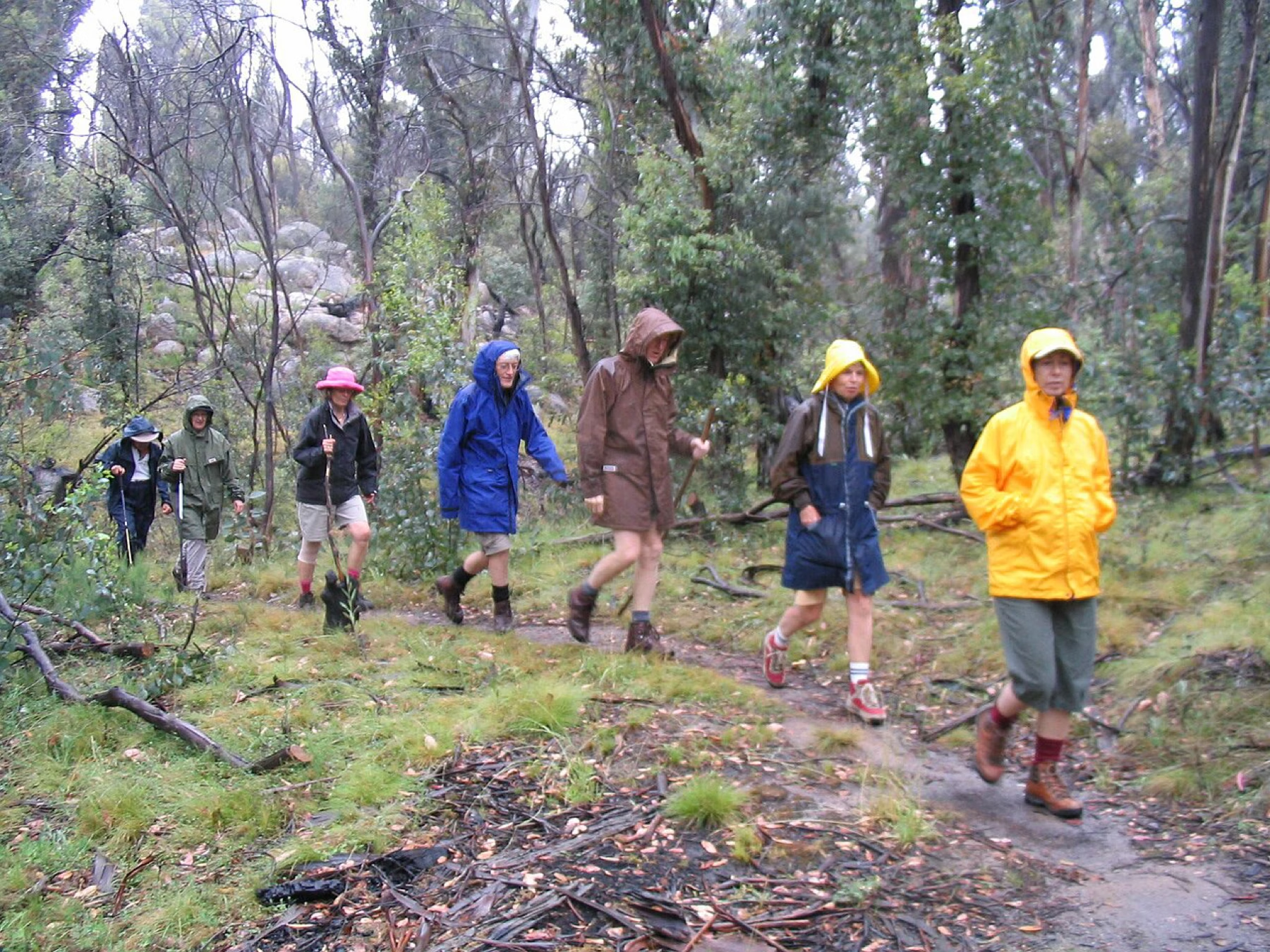
Photo: Michael Jordan, CC BY-SA 2.0, via Wikimedia Commons
How to Choose Hiking Rainwear in Japan: Preventing Hypothermia, GORE-TEX Types, and Key Specs
How to choose waterproof-breathable hiking rainwear in Japan—why rainwear is vital for preventing hypothermia even in summer, differences between GORE-TEX Pro, Active, Paclite, and ePE, and how to read waterproofness and breathability ratings.

In mountain hiking, rainwear (レインウェア) is far more than an umbrella substitute: it is life-safety equipment that protects your core body temperature from the combined effects of wetness and wind.
This guide explains why a separate waterproof-breathable jacket and pants set is mandatory on Japanese mountain trails, how GORE-TEX (Pro, Active, Paclite, and ePE) and proprietary membranes differ, how to read hydrostatic head and breathability ratings, and when to put your rain shell on.
1. Why Rainwear Is Mandatory: Preventing Hypothermia
According to Hokkaido Prefecture's mountain safety guidance, hypothermia (低体温症) was the primary cause of the July 2009 Mount Tomuraushi tragedy in the Daisetsuzan range, in which eight hikers lost their lives in mid-summer. Hypothermia occurs when deep core body temperature drops below 35°C because heat loss outpaces the body's ability to generate warmth—and it can happen at any elevation and in any season, including summer.
Hokkaido Prefecture highlights two fundamental measures to prevent rapid heat loss on the mountain:
- Stay dry: Put on rainwear against rain, and change out of sweat- or rain-soaked base layers promptly.
- Block the wind: Put on a windproof shell or rainwear whenever wind picks up on an exposed ridge.
A mountain rain suit therefore has to perform three jobs simultaneously: waterproofing (防水) to block rain from the outside, windproofing (防風) to stop cold wind from stripping body heat, and breathability (透湿) to let sweat vapor escape from the inside so you do not soak yourself from within.
2. Waterproof-Breathable Membranes Explained


GORE-TEX Product Lines
According to the official GORE-TEX product guides, each GORE-TEX construction is engineered for a distinct balance of durability, weight, and breathability rather than a single hierarchy:
- GORE-TEX PRO: A rugged 3-layer construction built for severe alpine environments, prioritizing abrasion resistance and long-term durability against rocks and heavy pack straps.
- GORE-TEX Active: A lightweight 3-layer construction engineered for maximum breathability during high-output aerobic activities.
- GORE-TEX Paclite: An unlined 2.5-layer construction that prioritizes light weight, supple feel, and compact packability inside a daypack.
- Next-Generation ePE Membrane: Introduced across outdoor lines from Fall/Winter 2025, GORE-TEX's expanded polyethylene (ePE) membrane is PFAS-free (free of intentionally added per- and polyfluoroalkyl substances) while maintaining a high strength-to-weight ratio. Montbell's current Rain Trekker Jacket utilizes this GORE-TEX 3-layer ePE construction.
Proprietary Manufacturer Membranes
Outdoor brands also develop high-performance proprietary waterproof-breathable membranes. Montbell, for example, uses its own DRY-TEC (ドライテック) and Super DRY-TEC (スーパー ドライテック) membranes alongside GORE-TEX—including on the 10th-generation Storm Cruiser Jacket, which uses a 3-layer Super DRY-TEC construction.
3. How to Read Spec Numbers (Waterproofness & Breathability)
Montbell states that mountain rainwear requires a hydrostatic head (waterproof rating / 耐水圧) of at least 20,000 mm to withstand wind-driven mountain rain and the pressure of backpack shoulder straps. Breathability (透湿性) is commonly expressed in $\text{g/m}^2\cdot 24\text{ hrs}$ under the JIS L-1099 B-1 test method.
| Montbell Model (Men's) | Membrane & Face Fabric | Avg. Weight | Breathability (JIS L-1099 B-1) | Waterproof Rating | Official Price (Tax Incl.) |
|---|---|---|---|---|---|
Thunder Pass Jacket (#1128770) |
DRY-TEC 3-layer (50D nylon ripstop) | 325 g | $15,000\text{ g/m}^2\cdot 24\text{h}$ | $\ge 20,000\text{ mm}$ | 14,000 yen |
Rain Trekker Jacket (#1128729) |
GORE-TEX 3-layer (50D nylon ripstop) | 301 g | $20,000\text{ g/m}^2\cdot 24\text{h}$ | $\ge 20,000\text{ mm}$ | 29,200 yen |
Storm Cruiser Jacket (#1128733) |
Super DRY-TEC 3-layer (30D Ballistic nylon ripstop) | 254 g | $40,000\text{ g/m}^2\cdot 24\text{h}$ | $\ge 20,000\text{ mm}$ | 28,600 yen |
Note: Even among 3-layer jackets, face-fabric denier (thickness) and membrane choice change the weight, pack size, abrasion resistance, and breathability. Test values are reference figures measured under laboratory conditions.
4. Six Checkpoints When Choosing Rainwear
- Match the fabric to your mountains: For forested low-mountain day hikes, lightweight and compact models work well. For rocky alpine ridges, brushy trails, or multi-day traverses, prioritize a tougher 3-layer shell (30D–50D or higher).
- Check packed weight and stuff-sack size: Rainwear spends most of a dry hike inside your pack, so compact storage matters.
- Hood, cuffs, and hem adjustments: Make sure the hood has 3-way adjustment cords so it turns with your head in strong wind without blocking vision, and check whether it fits over a climbing helmet if you hike rocky peaks.
- Pocket placement and water-resistant zippers: Verify that hand pockets sit high enough to remain accessible above a fastened backpack hipbelt.
- Always carry a separate top and bottom set: Pair your rain jacket with dedicated waterproof rain pants. Many brands (including Montbell) sell jackets and pants separately so you can choose your exact waist and inseam length.
- Try it on over a mid-layer: Fit the jacket over a fleece or light down layer to ensure your arms can reach overhead without pulling the hem up.
5. When to Put It On & How to Care for It
- Put rainwear on early: Do not wait until you are already damp. Put your jacket and pants on before stepping out onto an exposed ridgeline or as soon as the first drops begin—putting a shell over wet clothing traps moisture next to your skin.
- Avoid overheating inside the shell: Slow your uphill pace slightly once zipped up, and vent heat early using pit zips or front zippers.
- Wash and restore DWR water repellency: When dirt or sweat oils clog the outer fabric, water stops beading on the surface ("wetting out"), which blocks breathability even if the membrane isn't leaking. GORE-TEX recommends washing the garment according to its care label and applying gentle heat (tumble dryer or warm iron with a cloth barrier) to reactivate the durable water repellent (DWR) finish, reapplying a DWR treatment when heat alone no longer restores beading.
6. Frequently Asked Questions
Can I hike in a 100-yen convenience-store vinyl raincoat or poncho?
No. Vinyl raincoats tear easily on branches, flap violently in ridge winds, and have zero breathability—meaning your own sweat quickly drenches your clothes from the inside and triggers post-sweat chill. Always carry a separate, breathable mountain rain jacket and pants set.
Can I just use an umbrella instead?
On steep trails, rocky steps, or windy ridgelines, holding an umbrella occupies one hand, catches the wind, and increases the risk of a fall. Keep both hands free by wearing rainwear.
Do I really need rain pants too?
Yes. Rain running off the hem of your jacket flows directly onto your thighs and down into your boots. Once your lower body and socks are soaked, your leg muscles cool rapidly and your risk of cramps and hypothermia rises sharply.
Reference Links
- GORE-TEX Official: GORE-TEX PRO Products
- GORE-TEX Official: GORE-TEX Active Products
- GORE-TEX Official: Next-Generation ePE Products
- Montbell Official Online Store: Thunder Pass Jacket Men's (#1128770)
- Montbell Official Online Store: Rain Trekker Jacket Men's (#1128729)
- Montbell Official Online Store: Storm Cruiser Jacket Men's (#1128733)
- Hokkaido Prefecture: Preventing Summer Mountain Accidents & Hypothermia