Photo: Paxtonholley, CC BY-SA 3.0, via Wikimedia Commons
Hiking Packing Checklist for Japan: Essential Day-Hike Gear, Seasonal Extras, and Packing Tips
Complete packing checklist for day hiking in Japan based on Nagano Prefecture's Climbing Safety Book—covering mandatory safety gear, hydration formulas, seasonal additions, and backpack weight balance.

Checking your pack the night before a hike is one of the simplest ways to prevent trouble on the mountain. Even on a half-day low-mountain trail with a sunny forecast, forgetting a single essential item—such as rainwear, a headlamp, or a mobile power bank—can leave you vulnerable if your pace slows down or an afternoon shower rolls in.
This guide organizes a practical day-hiking packing checklist for Japan, based on the equipment standards published in Nagano Prefecture's Climbing Safety Book and prefectural mountain safety ordinances, along with tips on how much water to carry and how to load your backpack so it feels lighter on your shoulders.
1. Essential Gear (Carry on Every Hike)
The items below should stay in your pack on every day hike, regardless of the season or how clear the morning sky looks.
Worn on Your Body & Footwear
- Trekking shoes / hiking boots: Broken-in footwear with lugged soles and ankle support matching the terrain
- Quick-drying base layer (top & bottom): Synthetic (polyester) or merino wool; avoid cotton, which retains sweat and causes post-sweat chill (
汗冷え) - Trekking pants: Stretchy, water-repellent pants that allow high knee lifts
- Trekking socks: Thick cushioned wool or synthetic socks that protect against blisters
- Hat or cap: Sun and heatstroke protection in summer; warmth in cooler months
- Trekking gloves: Protect palms on rocky sections, tree roots, chains, and cold ridges
Safety & Emergency Essentials Inside Your Pack
- Waterproof/breathable rainwear (separate jacket and pants): Doubles as a windproof shell on exposed ridges; vinyl ponchos tear easily and trap sweat
- Insulating mid-layer (fleece or lightweight down jacket): Summit temperatures drop by roughly 0.6°C per 100 m of elevation and feel even colder in the wind
- Headlamp (plus spare batteries or full charge): Essential even on day hikes in case a twisted ankle or transport delay keeps you on the trail past dusk; keeps both hands free unlike a smartphone flashlight
- Smartphone with offline GPS hiking map downloaded + paper map & compass: Cell service is absent in many mountain valleys; always pair your phone with a mobile power bank and charging cable
- Submitted climbing plan (
登山計画書) copy: Filed online or dropped at the trailhead box, with a copy left with family or an emergency contact - Water / hydration (1.5–2.0 L for a typical day hike): Include oral rehydration solution or sports drink alongside plain water
- Trail food (
行動食) + lunch + 1 meal of emergency rations (非常食): Calorie-dense snacks you can eat quickly without cooking (nuts, energy bars, gels, chocolate, rice balls) - First-aid kit & personal medications: Adhesive bandages, hydrocolloid blister pads, gauze, athletic/ankle tape, pain relievers, antiseptic wipes, and an emergency thermal survival blanket (
エマージェンシーシート) - Emergency whistle: Often built into a backpack's sternum-strap buckle; carries much farther than a human voice if you need help
- Cash (1,000-yen notes and 100-yen coins) + IC transit card + health insurance card (copy): Mountain toilets (typically 100–300 yen), rural buses, and trailhead farm stands frequently accept cash only
- Trash bags & zip-top plastic bags: Under Japan's Carry In, Carry Out rule, mountain trails have no trash bins; bring every wrapper, fruit peel, and used tissue home
2. How Much Water Should You Pack?
Water is the heaviest item in a daypack, so carrying far too much adds unnecessary strain while carrying too little risks dehydration and leg cramps. A widely used sports-physiology formula for estimating fluid needs during a hike is:
$$\text{Fluid intake during hike (ml)} \approx (\text{Body weight in kg} + \text{Pack weight in kg}) \times \text{Walking hours} \times 5$$
Example calculation:
- Body weight: 60 kg
- Backpack weight: 5 kg
- Planned walking time: 5 hours
- Estimated requirement: $(60 + 5) \times 5 \times 5 = \mathbf{1,625\text{ ml}}$
Adding a 350–500 ml safety margin (for emergencies, cleaning a scrape, or delays) brings the total to roughly 2.0 liters: for instance, two 500 ml bottles of sports drink kept within easy reach plus a 1.0 L water bottle inside the pack. On hot summer hikes, increase this amount; on routes with confirmed mountain huts selling drinks, you can plan refills accordingly.
3. Useful Comfort & Hygiene Items
- Sunscreen & UV-blocking sunglasses: Ultraviolet radiation increases by roughly 10–12% per 1,000 m of elevation
- Trekking poles (1 or a pair): Reduce knee impact on descents and improve balance on stream crossings and steps
- Pack cover & waterproof dry bags / inner liner: Even with a pack cover, rainwater can seep along the back panel; seal electronics, spare clothes, and your down jacket inside waterproof zip bags
- Tissues / toilet paper (core removed, in a zip bag) & wet wipes / alcohol hand sanitizer: Many mountain toilets do not have running water for washing hands
- Portable emergency toilet kit (
携帯トイレ): Strongly recommended on crowded routes or trails with limited restroom facilities - Small folding foam sit pad (
ざぶとん): Keeps you warm and dry when sitting on damp wooden benches or cold rocks during lunch - Change of shirt & socks (kept in a locker or car, or in a waterproof bag): Changing into dry clothes immediately after descending prevents chill on the train or bus ride home
4. Seasonal Additions
Spring (March–May) & Autumn (October–November)
- Extra cold-weather accessories: Knit beanie, neck gaiter, and windproof/waterproof over-gloves
- Disposable hand warmers (
カイロ) & a vacuum insulated flask with hot water: A cup of hot tea or soup at a windy summit restores core warmth quickly - Chain spikes (microspikes) or light crampons: Essential from late October in high mountains (above 2,000 m) and through May on residual spring snowfields (
残雪) - Bear bell (
熊鈴) or portable radio: Recommended on forested trails in central and northern Japan
Summer (June–September)
- Electrolyte tablets / salt candies & oral rehydration powder: Sweating depletes sodium as well as water; plain water alone can lead to muscle cramps
- Insect repellent & bite relief ointment: Protects against gnats (
ブヨ), horseflies (アブ), mosquitoes, and ticks (マダニ); wear long sleeves and tights rather than exposing bare skin - Extra spare base layer: Summer thunderstorms and heavy sweating make a dry spare shirt especially valuable
5. Additional Gear for Specific Mountains
- Climbing helmet: Strongly recommended (and designated by Nagano and Yamanashi Prefectures on specific rocky peaks) for routes with rockfall hazards, chains, or scrambling—such as Mount Yatsugatake (Akadake / Yokodake / Iodake), the Northern Alps, Mount Kinpu, Mount Mizugaki, and Mount Ryokami
- Volcanic safety awareness: When climbing active volcanoes monitored by the Japan Meteorological Agency (such as Mount Fuji, Mount Ontake, Mount Nasu, Mount Kusatsu-Shirane, or Mount Azuma), check the current Volcanic Alert Level before departure and carry a helmet, dust mask/towel, and goggles where advised
6. How to Pack Your Backpack (Weight Distribution)
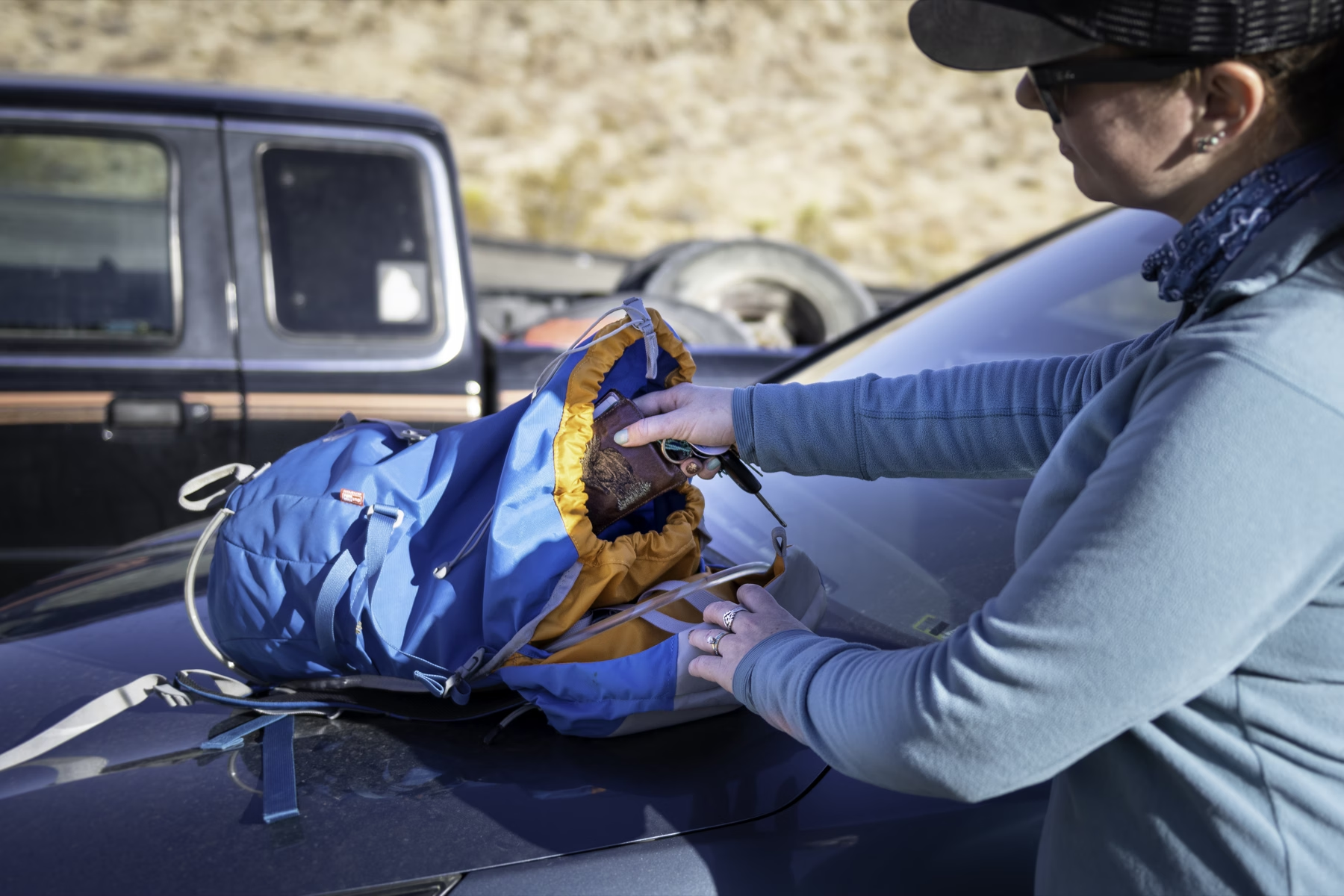

The same 6 kg of gear can feel either stable and light or awkwardly heavy depending on where each item sits inside your pack. Follow two core principles: place heavy items high and close to your spine, and keep frequently used items accessible without unpacking everything.
| Pack Zone | What to Put There | Why |
|---|---|---|
Top lid pocket (雨蓋) & hipbelt/side pockets |
Rainwear, headlamp, map, sunscreen, snacks, 500 ml drink bottle, tissues, first-aid kit | Grab in seconds when rain starts or during a short standing break |
| Upper & middle main compartment (close to your back) | Spare water bottle, insulated flask, lunch, heavy electronics/battery | Keeps the center of gravity high and close to your body so the pack does not pull you backward |
| Upper outer side (away from spine) | Fleece or mid-layer jacket | Easy to reach when stopping for a rest without shifting heavy loads |
| Bottom of the pack | Emergency spare clothes, thermal blanket, lightweight bulky items | Cushions the base of the pack and is only needed at the end of the hike or in an emergency |
Reference Links
- Nagano Prefecture: Climbing Safety Book & Seasonal Mountain Information
- Nagano Prefecture: Submit Your Climbing Plan (
登山計画書) - Nagano Prefecture: Designated Mountains Encouraging Climbing Helmet Use
- River Foundation (Mizu.gr.jp): Hydration Guidelines on the Trail — Prof. Masahiro Yamamoto
- Japan Meteorological Agency: Volcanic Activity & Alert Levels across Japan