
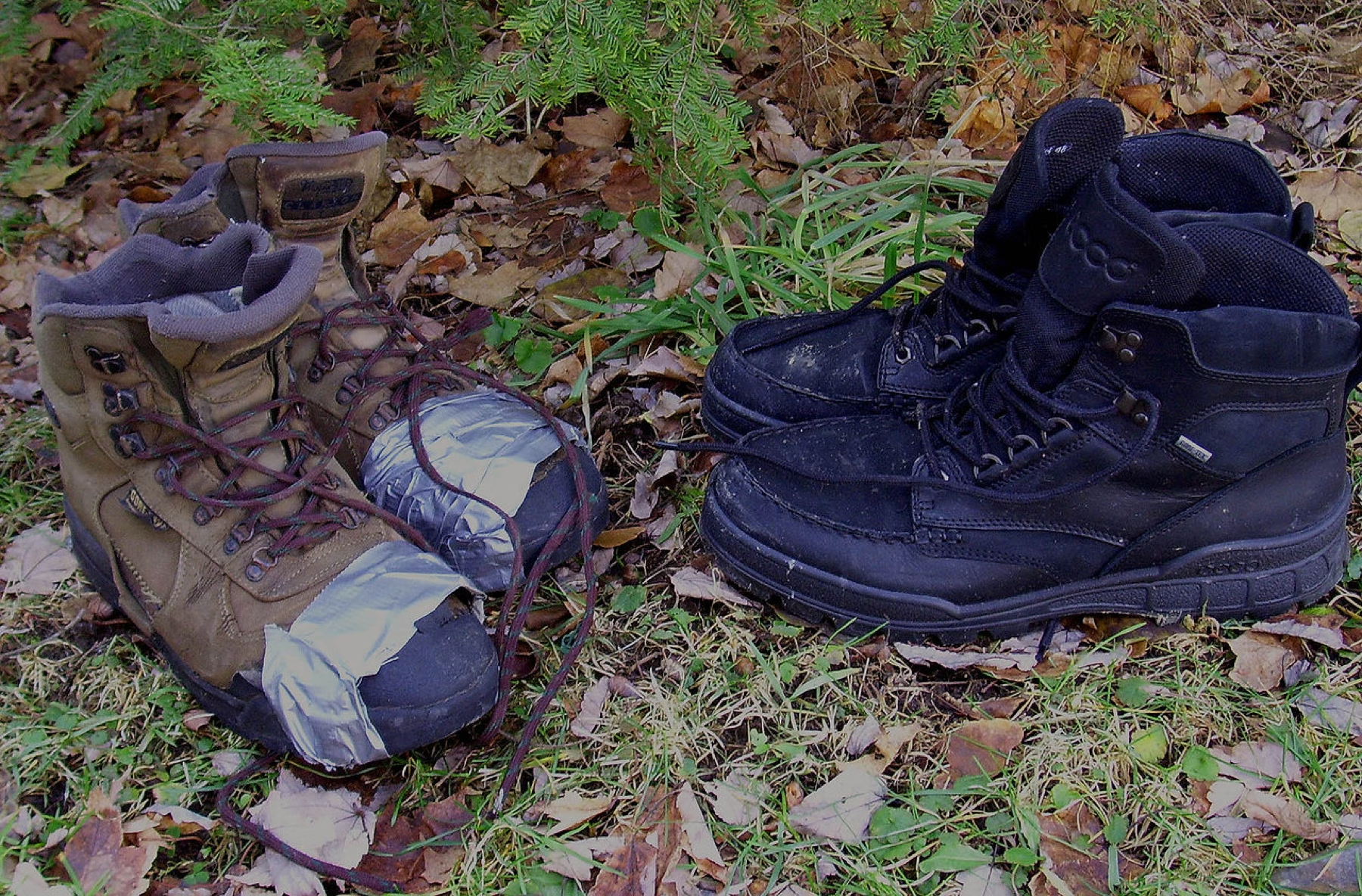
Photo: Daniel Case, Wikimedia Commons (CC BY-SA 3.0 / GFDL)

Hiking Boot Welts Explained: How Toe and Heel Welts Determine Crampon Compatibility
Learn what hiking boot welts (koba) are and how toe and heel welts determine whether your boots take strap-on, semi-automatic, or automatic step-in crampons, based on Montbell's official Kajitax crampon guide.
If you start looking for mountaineering or winter-ready hiking boots in Japan, you will quickly come across the Japanese term koba (コバ)—known in English as a boot welt (or crampon welt).
As Montbell explains in its official Kajitax crampon guide, a boot welt is the rigid ledge or lip projecting at the junction between the upper and the sole at the toe and/or heel of a mountaineering boot, designed to hold a crampon's toe bail or heel lever securely in place. Whether a boot has welts—and whether those welts are at the heel only or at both the toe and heel—directly determines which crampon binding systems you can use and what kind of snowy or icy terrain you can safely tackle.
This guide breaks down what boot welts are, the three categories of boots by welt configuration, how each crampon binding system works, and what to check in the shop before heading into snowy mountains in Japan.
What Is a Boot Welt (Koba)?
A boot welt (コバ, koba) is a pronounced, rigid step or lip molded into the edge of the sole where it meets the boot upper. While the word is also used in traditional shoemaking for the strip of leather stitched around a dress shoe's sole, in mountaineering and hiking gear it refers specifically to the load-bearing ledge used to lock crampon hardware onto the boot.
When you use step-in (automatic) or hybrid (semi-automatic) crampons on snow and ice, the metal wire bail at the toe and/or the camming lever at the heel clamp directly onto these welts. If the welt is absent, rounded, or too soft, the binding can pop off mid-step—a serious hazard on steep snow slopes or icy ridges.
Many three-season hiking boots designed for snow-free trails have no welts (or only a soft, decorative sole edge) and therefore cannot accept automatic or semi-automatic crampons.
Toe Welts vs. Heel Welts
Crampon welts are built in two positions on a mountaineering boot:
- Toe welt (
前コバ, mae-koba): The rigid notch or ledge at the front of the sole where the crampon's front metal wire (toe bail) hooks over the boot. - Heel welt (
後ろコバ, ushiro-koba): The rigid ledge at the back of the sole where the crampon's rear camming lever (heel lever / heel bail) snaps shut.
Boots with solid welts at both the toe and heel can take full step-in (automatic) crampons. Boots with a solid welt only at the heel can take semi-automatic crampons. Always check the boot manufacturer's official specifications to confirm whether a model is rated for toe-and-heel or heel-only crampon bindings.
Three Boot Categories by Welt Configuration
Mountaineering and trekking footwear can be grouped into three broad categories according to welt design and crampon compatibility:
| Boot Category | Toe Welt | Heel Welt | Compatible Crampon Types | Key Requirement |
|---|---|---|---|---|
| No Welts (Non-welted) | No | No | Strap-on (tape/basket) crampons | Can be fitted to boots without welts, provided the sole is stiff enough |
| Heel Welt Only | No | Yes | Semi-automatic (hybrid) & strap-on crampons | Requires a rigid, well-defined heel welt |
| Toe & Heel Welts (Fully Welted) | Yes | Yes | Automatic (step-in), semi-automatic & strap-on crampons | Requires rigid, full-strength welts front and back and a rigid sole |
Even when a Japanese retail listing says "koba-ari" (コバあり, welted), be sure to check whether it means both front and rear welts or rear welt only, as that changes your crampon choices. Before buying boots, decide what level of snow or alpine routes you plan to climb so you can match the boot and crampon system together.
Crampon Binding Systems and How They Match Boot Welts
Crampons use three main binding systems, each requiring a specific boot welt configuration:
1. Strap-On Crampons (Tape / Basket Type)
Strap-on crampons (called Tape Type (テープタイプ) by Montbell) secure both the toe and heel using flexible resin harnesses and webbing straps rather than metal bails or heel levers.
- Boot compatibility: Can be attached to boots without welts, and Montbell notes that tape-type bindings can also be fitted over winter overboots.
- Fitting tip: Because the binding relies on webbing tension rather than a mechanical lever, you must thread the straps in the exact sequence specified by the manufacturer and cinch them down firmly so nothing works loose while walking.
2. Semi-Automatic Crampons (Hybrid / Heel-Lever Type)
Semi-automatic crampons (such as Montbell's Kajitax LXB-12) use a camming lever on the heel combined with a flexible resin harness over the toe.
- Boot compatibility: As Montbell specifies, semi-automatic crampons can only be mounted on boots with a rigid, well-defined heel welt. Because the front uses a toe harness instead of a wire bail, they fit boots that have a heel welt but lack a toe welt (or whose toe shape does not match a wire bail).
3. Automatic Crampons (Step-In / Dual-Bail Type)
Automatic crampons (such as Montbell's Kajitax LXF-12) lock onto the boot using a metal wire bail at the front and a camming lever at the rear.
- Boot compatibility: Montbell specifies that automatic crampons can only be mounted on boots with solid, rigid welts at both the toe and heel. Because they clamp the boot with high mechanical force, they are suited to winter ridge traverses and alpine climbing—provided the crampon's bail geometry matches the boot's contour closely.
Four Key Points When Choosing Welted Boots and Crampons
1. Decide Your Target Mountains First
Start by clarifying what kind of snowy terrain you plan to hike:
- Light 6-to-8-point crampons or chain spikes: Used for summer snowfields or gentle, low-angle trails after a light snowfall; they lack front points and are not suitable for steep or icy winter mountains.
- Full 10-to-12-point crampons: Standard for steep snow slopes, hard-packed snow, and icy ridges where front points and heel points are essential for kicking steps and descending safely.
Always check the latest trail and snow conditions from local municipalities and mountain huts, and consult knowledgeable outdoor shop staff when pairing boots and crampons.
2. Check Sole Rigidity (Shank Stiffness)
Welts alone are not enough. In its official Kajitax instructions, Montbell warns: "Do not use crampons on boots whose soles (shanks) are too soft." If a boot flexes excessively while walking, the rigid metal crampon frame can lever off the welt or suffer metal fatigue over time.
3. Test the Exact Boot-and-Crampon Pairing in Person
Even if your boot size falls within a crampon's stated size range, Montbell notes that certain boot shapes may not fit even within the nominal size range, and warns that mounting crampons on boots of mismatched size or contour creates a serious hazard of the crampon coming off. Always bring your actual boots to the shop (or test-fit them thoroughly before your trip) and check three points:
- No gap between the sole and the crampon frame: The boot lugs should sit solidly on the crampon platform without rocking.
- Snug toe and heel engagement: Both the front bail/harness and the rear lever/harness should hug the boot profile without play.
- Matching width: The side rails of the crampon should match the width of the boot sole closely—including wide-fit models (such as Montbell's wide crampon versions) if you wear wide-soled winter boots.
4. Adjust Lever Tension Firmly and Maintain Your Welts
After every hike, brush off snow, mud, and grit and dry both boots and crampons thoroughly. On automatic and semi-automatic bindings, a loose heel lever can pop off under load; adjust the heel bail dial so the lever snaps over the heel welt with firm resistance. If your boot welts become rounded or chewed up from rock scrambling, consult the boot manufacturer or a specialty repair shop before relying on them in winter terrain.
Frequently Asked Questions
Q. Can I climb winter mountains by strapping light crampons onto regular three-season hiking boots?
Light crampons (4 to 8 points) have fewer spikes and no front points at the toe or heel, so they are not designed for steep, hard-packed winter snow slopes. On steep or icy mountain terrain, 10-to-12-point crampons paired with stiff, insulated boots are standard. Always verify current mountain conditions and ask experienced mountaineers or specialty shop staff before choosing gear for a specific peak and season.
Q. Can I attach automatic (step-in) crampons to boots without welts?
No. As Montbell states, automatic step-in crampons can only be attached to boots that have solid, rigid welts at both the toe and heel. Never attempt to force a wire toe bail or heel lever onto a non-welted boot.
Q. What if I rent boots or crampons?
Rental availability and models vary by shop. If you rent either boots or crampons, always have the shop staff fit the exact boot and crampon together and verify the adjustment before you head to the trailhead.
Summary: Boot Welts Are the Critical Link Between Your Boots and Crampons
- Boot welts (
コバ, koba) are the rigid ledges at the toe and heel of a mountaineering boot sole that anchor crampon bindings. - Whether your boots have no welts, a heel welt only, or both toe and heel welts determines whether you can use strap-on, semi-automatic, or automatic step-in crampons.
- Sole stiffness is just as important as welt shape—soft-soled boots should not be paired with rigid alpine crampons.
- Always test-fit your exact boots and crampons together and adjust the binding length and lever tension before stepping onto snow.